 211 Check Website Graphic Feature
Explainer: South Sudan’s debt burden and sovereign vulnerability
Summary:
The Republic of South Sudan, as of October 2025, continues to face a critical sovereign debt crisis, characterised by extreme vulnerability and complex legal threats. The nation is officially classified by the joint World Bank/IMF Debt Sustainability Analysis (DSA) in 2021 as being at a high risk of external and overall public debt distress.
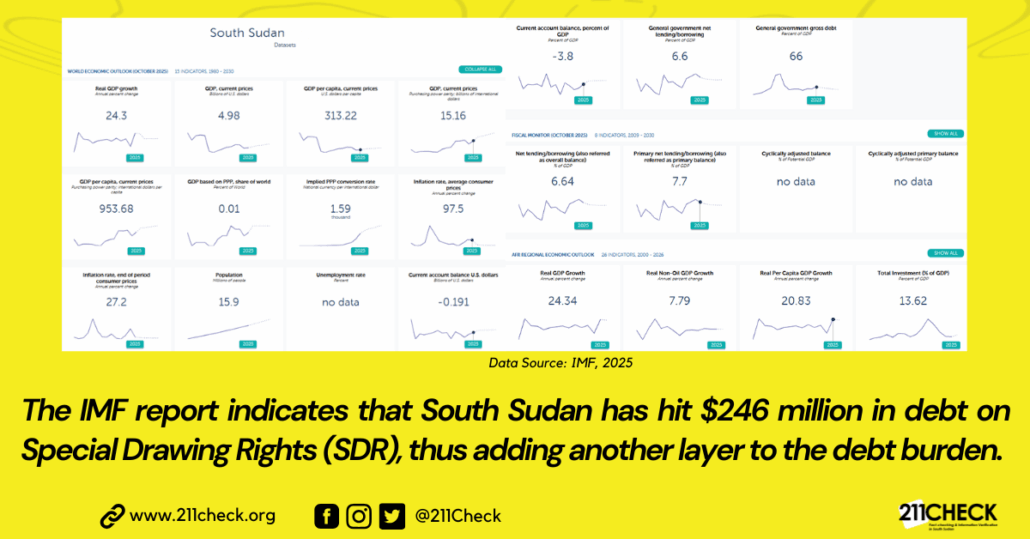
The official macroeconomic projections estimate the debt-to-GDP ratio at approximately 58 per cent of GDP for the 2024/2025 fiscal year, signalling large vulnerabilities. This macroeconomic fragility is further evidenced by a projected net lending/borrowing (overall balance) deficit of 6.64% of GDP in 2025, indicating high dependence on external or domestic financing.
The core issue driving the crisis, however, is not the official debt but an extensive portfolio of opaque, non-concessional commercial liabilities. This outstanding oil-backed debt stands near US$2.3 billion. These liabilities have recently matured into major international legal judgements, including a US$1 billion arbitration award for Qatar National Bank (QNB) and a US$657 million court order for the African Export-Import Bank (Afreximbank).
The combined total of these enforceable judgments, exceeding $1.65 billion, poses an immediate threat to the nation’s liquid assets and oil export streams.
This profound debt distress is identified as a direct consequence of systemic governance failure, specifically the persistent non-implementation of the Petroleum Revenue Management Act (PRMA) of 2013. The failure to operationalise mandated Sovereign Wealth Funds (SWFs) created a crucial fiscal vacuum, which was subsequently filled by high-interest, non-transparent borrowing.
Download the full analysis here

 211 Check Website Graphics


 211 Check Website Graphic Feature
Prestamos
Apoyó personal
سلام لطفاً واتساپ مرا غیر فعال کنین اینم اینجا خوارزاده ما بازی میکرد
زما وټساپ نه عکوس ورک دی پیدا به شی یانه