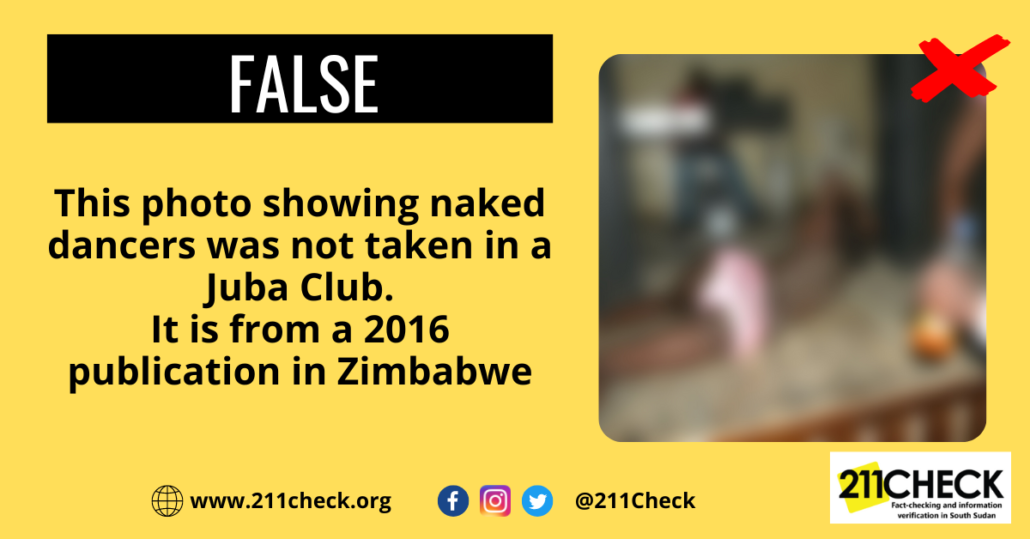
This photo doesn’t show an incident that happened in Juba; according to TinEye reverse image search, it has been used to describe events in Zimbabwe, and Nigeria in 2016 and 2018, respectively.
Writer: Beatrice Amude Paulino
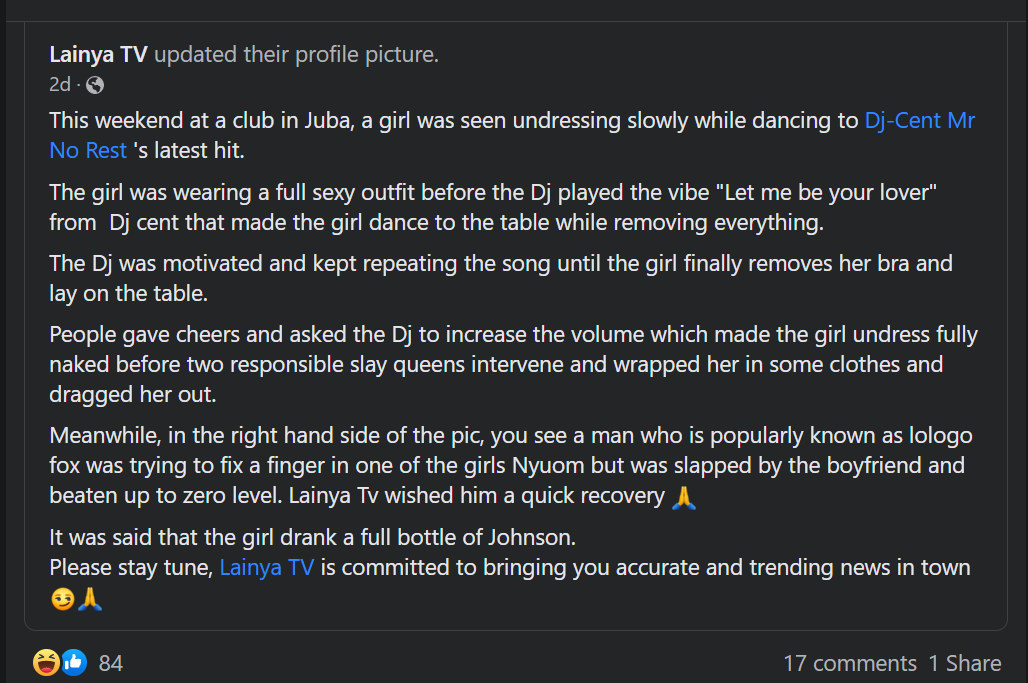
A Facebook post on the 4th December 2022 by Lainya TV claiming that “a girl was seen undressing while dancing” to music star DJ Cent is false and misleading.
The page claimed the photo of the dancers was taken in a disco club in Juba over the weekend.
“This weekend at a club in Juba, a girl was seen undressing slowly while dancing to Dj-Cent Mr No Rest ‘s latest hit. The girl was wearing a full sexy outfit before the Dj played the vibe “Let me be your lover” from Dj cent that made the girl dance to the table while removing everything,” reads part of the Facebook post.
“The Dj was motivated and kept repeating the song until the girl finally removes her bra and lay on the table. People gave cheers and asked the Dj to increase the volume which made the girl undress fully naked before two responsible slay queens intervene and wrapped her in some clothes and dragged her out,” it added.
The screenshot of the Lainya TV Facebook post
The post garnered about 30 comments, 33 shares, and 88 reactions as of writing this fact-check.
DJ Cent, who the post said the girl was dancing to his song, shared the post on his Facebook page and reacted by saying he needed the girl’s number so that he could bless her December.
However, 211 Check performed a reverse image search on the photo using TinEye, and it turned out that the photo was published on a websitein Zimbabwe in 2016, describing the growth of dancing naked in the country’s nightclubs.
The photo was also used in the circumstances described to be in a Nigerian club in 2018. And DJ Cent is also not in the photo, which the post claims shows a girl dancing to his song.
Conclusion:
This didn’t happen in Juba. According to TinEye reverse image search, the image has been used in the past to describe events in Zimbabwe, and Nigeria in 2016 and 2018, respectively.
https://211check.org/wp-content/uploads/2022/12/These-photos-do-not-show-a-drinking-competition-in-Juba-recently-2.png6281200211 Checkhttps://211check.org/wp-content/uploads/2020/03/211Check_logo-1-300x120.png211 Check2022-12-09 09:40:032022-12-09 09:40:06Fact check: No, this photo showing naked dancers was not taken in a Juba Club
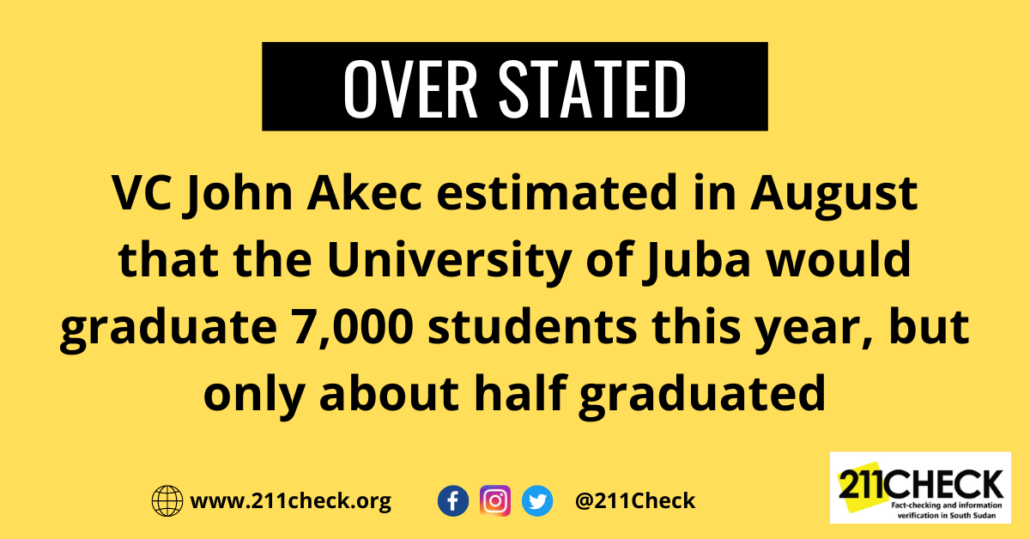
“He [John Akec] also informed H.E. the President about increase admissions of many students to public universities. Noting that this year [2022], the University of Juba will graduate 7,000 students,” the presidential press quoted John Akec in August this year.
This was when he met the president to inform him about the state of academic affairs at the university. The minutes of the meeting were posted on the verified Facebook page of the Office of the President – Republic of South Sudan.
“The number of intakes have increased and we are working to expand the number of lecture halls in our facility,” John added as quoted by the office of the president.
The screenshot of the Facebook post meeting minutes, by Office of the President
The Juba-based English daily newspaper City Review published a story titled “University of Juba to graduate 7,000 students” on August 23, 2022, about a day after the meeting, which it sourced from the Office of the President’s Facebook page post meeting minutes when Professor John Akec met the President.
‘‘I had a fruitful meeting with President Salva Kiir, and I hope there will be steady improvements in the state of affairs of public universities across the country,’’ VC Akec was quoted as saying by City Review.
The University of Juba held its 2022 graduation ceremony on November 26th. How many students graduated then? 7,000? Certainly not.
211 Check obtained professor John Akec’s structured presentation speech during the recently concluded graduation on the 26th November, 2022 at the University of Juba, which was presided over by Vice President James Wani Igga. He said the overall total graduands were 3,500 whereby only 2,400 were present; approximately 2,000 males and 400 females graduated respectively.
“Your excellency, the Vice President, and representative of the Chancellor, distinguished guests, graduands, parents, ladies and gentlemen. I want to congratulate our 3,500 graduands of today for their landmark achievement. Those in attendance today are about 2,400 graduands comprising about 2,000 males and 400 females. Of these, 12 will be awarded doctorate degrees, 513 will be awarded masters, 137 will be awarded postgraduate diplomas, 973 will receive bachelor degrees, [and] 737 will be awarded intermediate diplomas,” Vice Chancellor John Akec stated in his speech to the public.
Looking back at University of Juba graduation in 2021:
Only a year ago, in 2021, at least 1,756 students from various colleges and faculties at the University of Juba graduated. There were 1,452 males and 304 females among them according to reports by Eye Radio and Juba Echo.
Conclusion:
211 Check concludes that John Akec overstated in his August projection in which he claimed that 7,000 students would graduate from the University of Juba this year, 2022. Only 3,500 students graduated from the university in its 2022 graduation held on 26th November.
https://211check.org/wp-content/uploads/2022/12/OVER-STATED.png6281200211 Checkhttps://211check.org/wp-content/uploads/2020/03/211Check_logo-1-300x120.png211 Check2022-12-08 15:19:442022-12-08 15:24:28Fact-check: University of Juba VC overstated 2022 graduation figures in August
This was the ball supplied by the Uruguayans. The inaugural FIFA World Cup was held in Uruguay in 1930. Thirteen teams competed in the tournament.
Writer: Jibi Moses
A Facebook post by Alàbi Tolulope Micheal ATM, a page with 22,000 likes and 28,000 followers, sharing a photograph of the first World Cup ball used in 1930 is true.
‘The First World Cup ball used in the Final, 1930. ‘In the first World Cup final, held on July 30, 1930. 93,000 spectators looked on as Uruguay defeated Argentina 4-2 with this ball,’ the post read in part.
It spread like wildfire, getting more than 34,000 likes, 400 comments, and 590 shares. People reacted differently to the post, which could be seen in the comments, though many people thought it was a joke.
“I remember it was made of rock. Very durable,” commented Simon Mukabi. Raf Icon said, “…This ball has undergone surgery.”
A screenshot of the post by Àlàbi.
Was the ball in the post used in the 1930 final of the first World Cup? 211 Check takes a look at the claim.
A reverse image search on the image of the ball using Yandex brought many sites with the picture of the ball explaining the same. One of the sites is Wiki Commons, which writes in detail as this was one of the balls used in there was a disagreement between the two countries and this very ball was used in the second half, was provided by Uruguay and is currently kept in the National Football Museum, Preston. Some other sites also conform, as seen here, here,here, here, and here.
A screenshot of the search results from Yandex.
Conclusion:
211 Check finds that the ball in the photograph was one of the balls used in the final match between Argentina and Uruguay in 1930, and it is now housed in the National Football Museum in Preston.
https://211check.org/wp-content/uploads/2022/12/These-photos-do-not-show-a-drinking-competition-in-Juba-recently-1.png6281200211 Checkhttps://211check.org/wp-content/uploads/2020/03/211Check_logo-1-300x120.png211 Check2022-12-08 14:35:362022-12-08 14:35:39Fact-check: Yes, this was the ball used in the first World Cup final in 1930
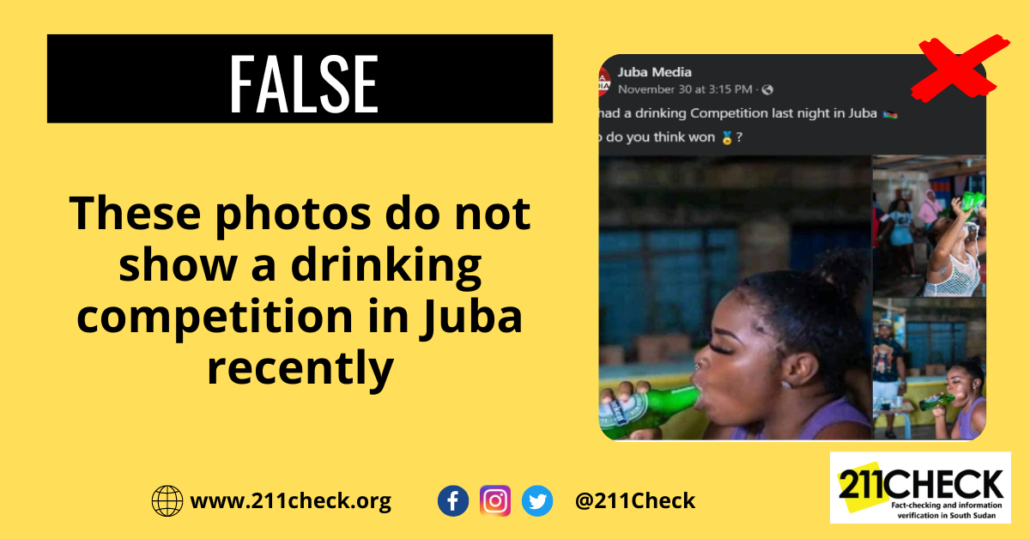
A Facebook post by Juba Media claiming that a drinking competition was held in Juba is false.
The post, which featured photos of some women drinking from the bottles of Heineken, asked people about who they thought would have won.
“We had a drinking competition last night in Juba. Who do you think won”? reads the postwithout mentioning where the event was held in Juba and which company organised it.
The screenshot of the false competition post by Juba Media
However, when the photos were verified by 211 Check using Google image lens, it appeared that it was tweeted on the Twitter handle Kulani on September 7th, 2022. And the tweet did not mention any drinking competition that took place in Juba.
Screenshot of the tweet by Kulani
Also, the tweet, which generated 107 retweets, 56 quote tweets, and 529 reactions, did not describe the purpose and the location of the photos where the event took place.
Typically brewery companies that sell drinks like beer organise drinking competitions as part of their marketing strategy campaign to promote their brands, and it attracts crowds involving entertainment.
But no such event had occurred recently in Juba, as the Juba Media Facebook post claimed.
Conclusion:
The Facebook post by Juba Media on the 30th of November 2022 that the drinking competition took place in Juba over the weekend is false. A public event of such has yet to be held recently.
https://211check.org/wp-content/uploads/2022/12/These-photos-do-not-show-a-drinking-competition-in-Juba-recently.png6281200211 Checkhttps://211check.org/wp-content/uploads/2020/03/211Check_logo-1-300x120.png211 Check2022-12-08 14:25:102022-12-08 14:25:13Fact-check: No, these photos do not show a drinking competition in Juba recently
The viral retirement speech allegedly written by Pope Francis and widely circulated on WhatsApp is a long-running hoax that has been online since 2021.
Writer: Deng Akok Madhan
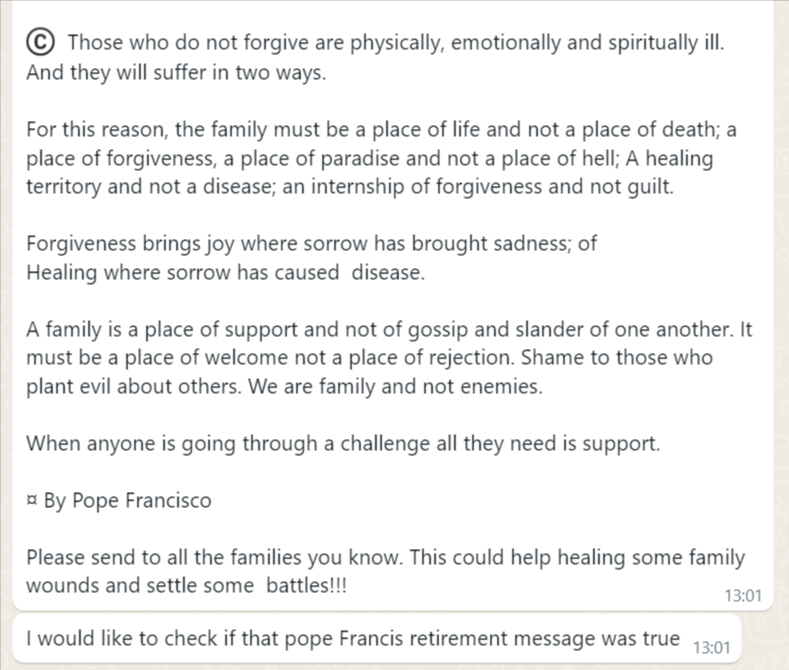
A WhatsApp message forwarded widely in groups about Pope Francis’s retirement speech that claims to have shocked the world is false.
The message, which urged people to read “regardless of religion,” centred on the family as a place of forgiveness.
“There is no healthy marriage or healthy family without the exercise of forgiveness. Forgiveness is the medicine of family joy and happiness. Forgiveness is vital to our emotional health and spiritual survival. No matter the offense or who is the offender. Without forgiveness, the family becomes an arena of conflict and a fortress of evil. Without forgiveness, the family becomes sick and unhealthy”, reads part of the message.
The screenshot of thewidely forwarded WhatsApp about Pope Francis’s claimed retirement speech
The Pope’s claimed speech continued to pin unforgiveness as toxins that kill anyone who can not forgive the other.
“Unforgiving is Evil and a poison that intoxicates and kills the one who refuses to forgive. Keeping the heartache of unforgiving in your heart is a self-destructive gesture. It’s autophagy. Those who do not forgive are physically, emotionally, and spiritually ill. And they will suffer in two ways. For this reason, the family must be a place of life and not a place of death; a place of forgiveness, a place of paradise and not a place of hell; a healing territory and not a disease; an internship of forgiveness and not guilt”, the message continues.
The screenshot of the WhatsApp message claimThe screenshot of the WhatsApp message claim
Is it true, however, that Pope France, the leader of the Roman Catholic Church, wrote the retirement speech that has been making the rounds on WhatsApp? Here’s what we discovered:
211 Check conducted research into the claim about Pope’s resignation. The claim was circulated a year ago and continued even though it was proven false after a fact check.
And lately, in July this year, Pope Francis refuted the same claim in an interview with Televisa Univision.
Conclusion:
Pope Francis has not tailored any resignation speech that is claimed to have shocked the world. The written resignation speech purportedly written by Pope Francis and circulated on WhatsApp is false.
https://211check.org/wp-content/uploads/2022/12/The-viral-retirement-speech-allegedly-written-by-Pope-Francis-and-widely-circulated-on-WhatsApp-is-a-long-running-hoax-that-has-been-online-since-2021..png6281200211 Checkhttps://211check.org/wp-content/uploads/2020/03/211Check_logo-1-300x120.png211 Check2022-12-06 11:33:262022-12-06 11:33:28Fact-check: No, Pope Francis has not written a retirement speech that is going around on WhatsApp
Cyber attacks are one of the most dangerous phenomena haunting people worldwide. The attacks, aided by information technology infrastructure and actors, cause severe damage to the lives of people everywhere.
Writer: Ochaya Jackson
Cyber crime is committed through illegal attacks by entities or individuals using collective methods of knowledge, device and the internet to get unauthorised access to computer systems, networks and other information technology devices.
Cyber-attacks are of various categories and take different dimensions depending on the attacker’s interests in the target. It combines techniques, skills, devices and the target’s vulnerability to accomplish a successful attack.
If they succeed in the attacks, data is compromised, devices are infected, and the victims are psychologically tortured as they are left with pain.
The cyber-attack actors are the crime organisations, the state, and the individual. The mission of the attack may differ, but it primarily is to harvest data from the targets that could yield millions or billions of dollars and information gathering.
There are many types of cyber-attacks, including phishing, SQL injection threat, man – in – the middle, cross-site scripting, distributed denial of service, password, AI-powered, drive, eavesdropping, ransomware, and so on.
These attacks are the most commonly used globally to commit cybercrime operations over the internet to compromise victims.
Even though the internet has many advantages, South Sudanese should be aware of its risks and dangers. This necessitates understanding cybercrime attacks and the methods used to carry them out.
Nobody can, however, eliminate cyber attacks, but understanding the dynamics of the attacks can help reduce attacks and save money and people’s lives.
According to the AAG IT Company 2022 cyber crime report, phishing attacks are widely executed.
“Phishing remains the most common form of cybercrime. Globally, 323,972 internet users fell victim to phishing attacks in 2021. This means half of the users who were a victim of cybercrime fell for a phishing attack. An average of $136 lost per phishing attack amounts to $44.2 million stolen by cyber criminals through phishing attacks in 2021”, part of the report reads.
The victims of cybercrime are targeted using emails, and in 2021, the report said about one billion emails were breached, and the data lost is sold to criminals to enhance further attacks.
“Phishing attacks largely target victims through emails; 2021 saw nearly 1 billion emails exposed, affecting 1 in 5 internet users. These breached databases are sold on black marketplaces on the dark web, meaning cyber criminals can purchase them and use the addresses in phishing attacks”.
The Phishing Trends both in 2021 and 2022
The LinkedIn platform is where phishing email attacks are delivered because of its many users. In the first quarter of 2021, phishing emails attached to LinkedIn were highly clicked at 42%, followed by Facebook at 20% and Twitter at 9%.
LinkedIn
42%
Facebook
20%
Twitter
9%
Table showing phishing percentage attacks volume delivered through emails on social media
And in the first quarter of 2022, there are five top platforms which experienced phishing, with LinkedIn taking the lead at 52%, DHL at 14%, Google at 7%, Microsoft at 6%, and FedEx at 6%.
LinkedIn
52%
DHL
14%
Google
7%
Microsoft
6%
FedEx
6%
Table showing phishing attack volume delivered through different platforms
The rationales for the increase in the cost of cybercrime are that cybercriminals have developed new attack technologies, many countries have weak cybersecurity, cybercrime has turned into a service or business, and the criminals monetise their targets, according to Internet Society Organization.
In an article published by Security Magazine, which highlighted the state of phishing report for 2022 by SlashNext, it found 255 million attacks had taken place in the form of URL based-links, email messages, and mobile and browser channels, amounting to 61% higher than in 2021.
The report indicated that phishing attacks have shifted to mobile devices and communication channels, primarily targeting employees with scams and personal information theft.
Global Cybercrime statistics 2022
The worldwide trends of cybercrime have wrecked damages lost to institutions, individuals, and information technology devices.
In Europe, the United Kingdom has many cybercrime victims, numbering 4783 as of November 2022, above 40% compared with 2020.
In the first quarter of 2022, Russia had 42.92 million data breaches. However, it dropped to 28.78 million violations in the second quarter of 2022.
The United States of America accounts for 46% of cybercrime attacks worldwide. In Asia, Pakistan experienced an 83% increase in financial fraud committed through social media between 2018 and 2021.
In 2018, about 17,560 India-based websites were hacked, including 26,121 one in 2020 were hacked. In the African continent, Nigeria in 2022 has seen 1616% higher data breaches in the first quarter, 35 472 in the second quarter, and 608,765 in the third quarter.
In Australia, $72 million was lost in 2022 through scams. In September this year, Optus telecommunications company experienced a data breach that victimised about 2.1 million customers, and 9.8 million records were stolen.
In conclusion, with the advance in technology, cyber crimes have become more sophisticated, lucrative, and well-organized. The attackers evade the security layers or protocols of individuals, groups, organisations, institutions, and devices.
The victims of the attacks could be institutions, individuals, and information technology devices or infrastructures.
https://211check.org/wp-content/uploads/2022/12/pasted-image-0.png7671232211 Checkhttps://211check.org/wp-content/uploads/2020/03/211Check_logo-1-300x120.png211 Check2022-12-02 12:58:272022-12-02 12:58:32Blog: South Sudan must fortify its cyberspace as cybercrime attacks cost billions of dollars in losses globally
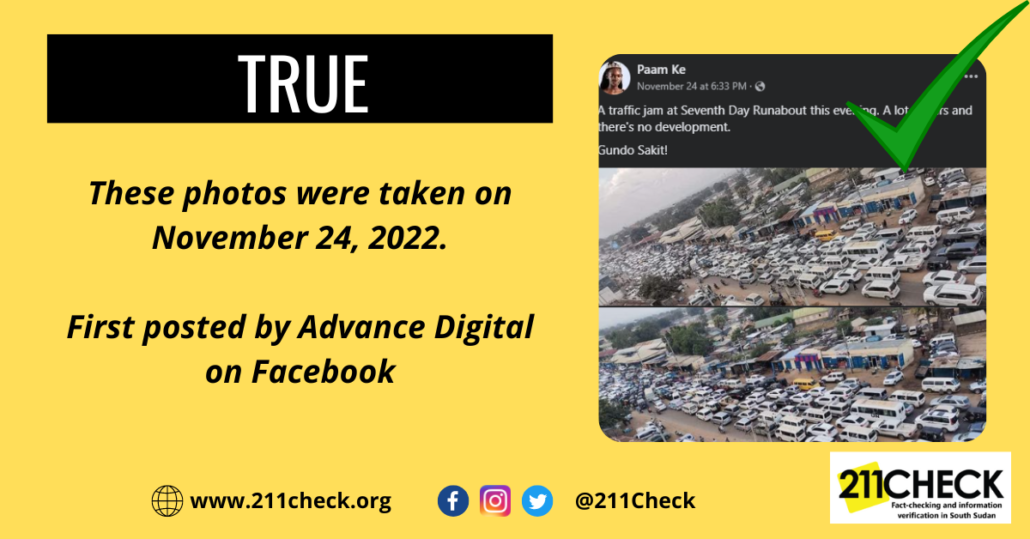
There was heavy traffic along Saint Kizito – Gudele street. If you look closely, there are water tanks common in South Sudan.
Writer Beatrice Amude Paulino
A Facebook post on 24th November 2022 by Paam Ke sharing pictures of a traffic jam along Gudele street in South Sudan’s capital city, Juba, is true.
“A traffic jam at Seventh Day Round about this evening. A lot of cars…,” partly reads the post‘s caption in which the pictures were shared.
But people said different things. Some people in the crowd were not sure if the photos were really taken on Gudele Street in Juba.
“I don’t think it’s the Seventh-day – Gudele street,” wonders one Mr. Malish Michael
“You are lying we don’t have these types of cars in South Sudan. Stop lying,” warned another.
Which begs the question, where exactly were these pictures taken? Why don’t we find out?
Using visual cues, one could see similar structures along the roads, an MTN billboard in the far left corner, a mGurush billboard in the far right ends, and some water tank trucks, which are common in Juba.
MTN billboard near Star Village Building and mGurush Billboard at the far right
A search on Facebook for “Gudele jam” yielded the same images that were first posted on November 24th, 2022, at 5:01 pm by Advance Digital, a Juba-based mainstream media company.
“Heavy Traffic Jam around St Kizito,” it captioned the pictures.
According to our observations, the photos were taken from the upper level of the building where Advance Digital is located, Star Village.
MTN billboard near Star Village Building and mGurush Billboard at the far rightJuba Electricity Distribution Company (JEDCO) poles and a transformer are also visible
Conclusion:
211 Check confirms that these photographs were taken on November 24, 2022, along Seventh-day – Gudele Street. They were taken from an aerial view of the Star Village Building, which is located on this road.
#FactsMatter, Don’t be a victim of fake news; instead, let’s fight misinformation on both mainstream and alternative media. To avoid spreading false information, don’t share content you’re unsure about or know where it comes from.
To learn more about our fact-checking process, go to https://211check.org/ or send us a WhatsApp message at +211 917 298 255 to present a claim, and our team will immediately fact-check it and respond.
https://211check.org/wp-content/uploads/2022/12/True-this-is-along-ST-Kizito-Gudele.png6281200211 Checkhttps://211check.org/wp-content/uploads/2020/03/211Check_logo-1-300x120.png211 Check2022-12-02 09:45:002022-12-02 09:45:03Fact-check: Yes, these images show a traffic jam along Seventh-day – Gudele street in Juba
A reverse image search returned results of the same pictures first related to an event in Nigeria in February 2020.
Writer: Jibi Moses
A Facebook post by a page called Charliebrain.com claiming that a wedding in South Sudan was disrupted because the bride’s ex-boyfriend stormed the ceremony with thugs is false.
The post, which was published on November 18th, 2022, claimed that the ex-boyfriend was demanding the $5,000 he spent on his now ex-girlfriend.
“Just in: South Sudanese boyfriend arrives with thugs and disrupts the traditional marriage of his ex, claiming he wants a refund of all he spends on his ex, and everything sums up to $5000,” the post reads.
The page describes itself as a TV channel and has 135000 likes and 138 followers.
Is it true, however, that such an incident has recently been reported in South Sudan? Here’s what we discovered:
The screenshot of the claim as posted by the Charliebrian.com page.
And an article was published by Face of Malawi with the heading Man Disrupts Ex-girlfriend’s Marriage, Demands for N22 million in Nigeria. Other similar articles include this, this, and this.
Besides, no credible media and bloggers have reported such an incident of wedding interruption in South Sudan recently.
Some of the screenshots from the search
Conclusion:
211 Check finds this claim false. According to media reports, the images were first taken in Nigeria in February 2022, when a traditional wedding was interrupted by an ex-boyfriend, but not in Juba.
https://211check.org/wp-content/uploads/2022/11/PLO-Patrick-Lumumba-False-Claim-1.png6281200211 Checkhttps://211check.org/wp-content/uploads/2020/03/211Check_logo-1-300x120.png211 Check2022-11-30 12:53:052022-11-30 12:53:07Fact-check: Was a traditional wedding interrupted by a jealous ex-boyfriend in Juba?
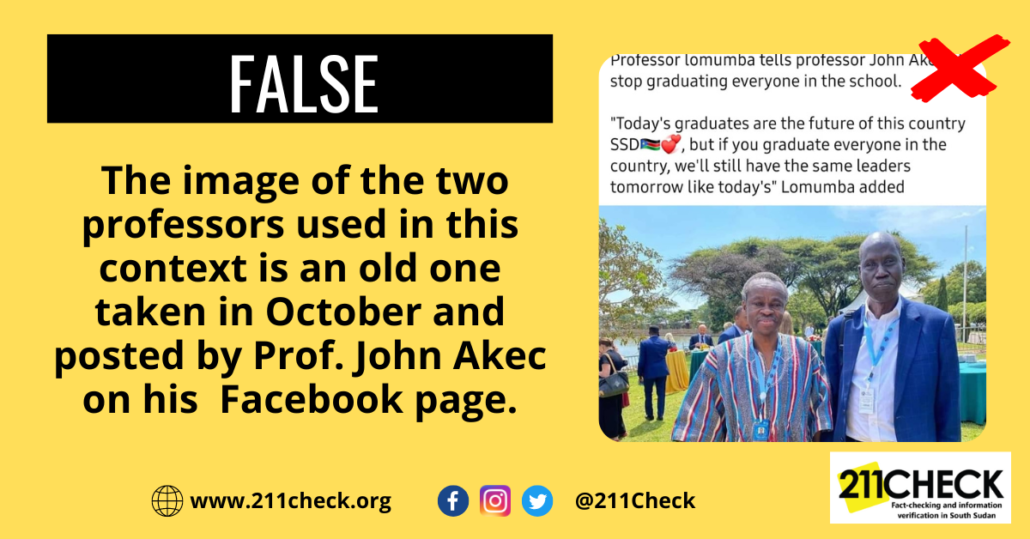
Prof. Patrick Lumumba didn’t advise the Vice Chancellor of the University of Juba not to graduate ‘everyone’. Also, the image of the two professors used in this context is an old one taken in October and posted by Prof. John Akec on his Facebook page.
Writer: Ghai Aketch
A social media post attributing a quote to Prof. Patrick Lumumba on November 28, 2022, in an unconfirmed conversation with the University of Juba’s Vice Chancellor, Prof. John Akec, is false.
Prof. Patrick Lumumba is a Kenyan national well-known for his Pan-Africanism advocacy on the continent and a High Court of Kenya and Tanzania advocate. He is also the chairperson and founder of the PLO Lumumba Foundation.
The post claimed that Prof. Lumumba said: “Today’s graduates are the future of this country SSD🇸🇸💞, but if you graduate everyone in the country, we’ll still have the same leaders tomorrow like today’s.” This is false.
“Professor Lumumba tells Professor John Akech to stop graduating everyone in the school,” the false post was headlined by Jonglei TV, a Facebook page with over 34,000 followers.
Screenshot of the post claiming Prof. Lumumba’s advice to Prof. John Akec
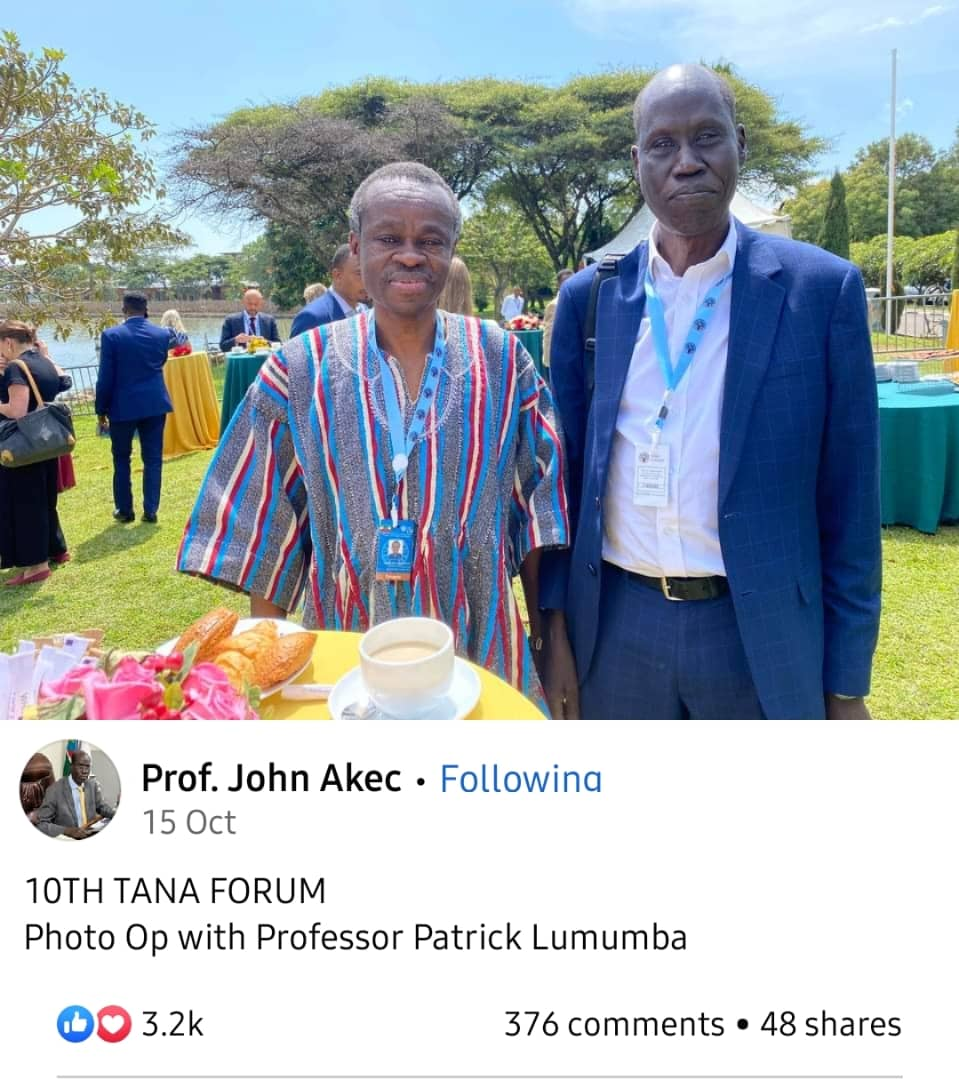
However, Professor Lumumba was not in attendance. Our image search of Prof. Lumumba and Prof. Akec, accompanying the claim, found that the two professors posed for the photo on October 15, 2022, during the 10th Tana High-Level Forum as posted by Prof. Akec on his official Facebook page.
Screenshot from Prof. John Akec’s official Facebook page
Moreover, our keyword and official page searches did not return any results about the claim. The image was, however, taken in Bahir Dar Ethiopia, during the 10th Tana High-Level Forum in October and not in Juba.
Interestingly, we discovered that PLO Lumumba’s verified Facebook, which has 945k followers, was allegedly hacked between the 18th and 20th of November, according to the verified PLO Lumumba Foundation page and thus, he is not in control of posting.
Conclusion:
211 Check, therefore, concludes that this claim is false. Prof. Lumumba was not in Juba during the University of Juba graduation event on 26th November 2022.
https://211check.org/wp-content/uploads/2022/11/PLO-Patrick-Lumumba-False-Claim.png6281200211 Checkhttps://211check.org/wp-content/uploads/2020/03/211Check_logo-1-300x120.png211 Check2022-11-30 12:42:092022-11-30 12:42:12Fact-check: Did Prof. PLO Lumumba advise Prof. John Akec of the University of Juba not to graduate everyone?
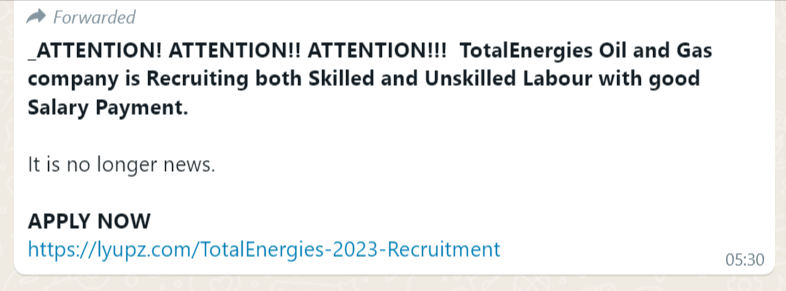
A widely circulated WhatsApp message claiming that Total Energies Oil and Gas Company is looking for skilled and unskilled labour workers with “good pay” is false.
TotalEnergies is a multi-energy company that produces and markets fuels, natural gas and electricity. Our 100,000 employees are committed to better energy that is more affordable, reliable, cleaner and accessible to as many people as possible. Active in more than 130 countries, its ambition is to become a responsible energy major.
The screenshot of the widely forwarded WhatsApp message
The application link attached to the WhatsApp message is a dangerous phishing mechanism, and here is why:
The link, which has been investigated by 211 Check, if once clicked, takes to a one-page form for filling in personal information and calls on applicants, regardless of nationality, to apply.
The screenshot of the application form
Once the application is filled, a pop-up message appears indicating that the application is in process and warns that the number of applicants is narrow.
The screenshot of the pop-up message
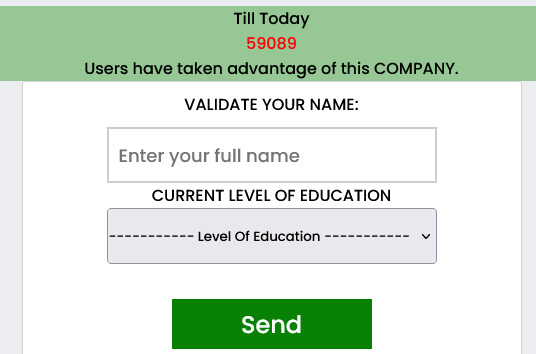
Continuing with the process brings on a page to validate the applicant’s name and fill in the current education status before sending the application.
The screenshot of the page
After validating and filling out the educational status, a congratulatory pop-up message appears with the assurance that one is qualified to serve in Total Energies Company. Still, it requires one to share with five groups or fifteen WhatsApp friends before a confirmation email detailing the successful application is sent.
The screenshot of the page
Websites Forensics
Total Energy has not advertised for the 2023 recruitment of both skilled or unskilled labor, and its websitedoes not bear any ongoing recruitment process.
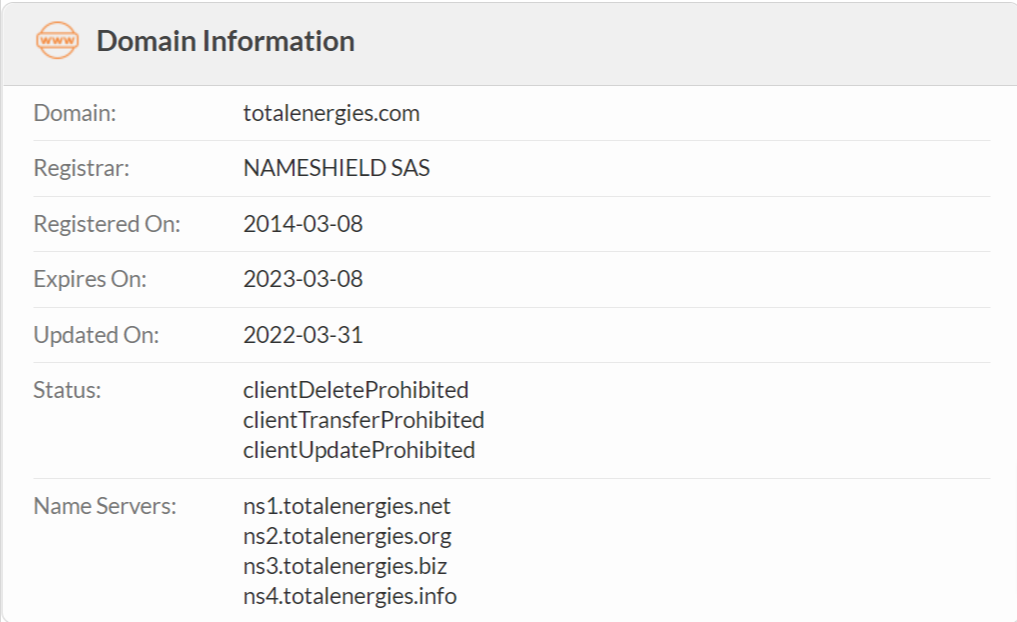
The whois information for the claim differs from the Total Energy company, the website domain was registered in January 2022, while the Total Energy website was in March 2014.
The whois screenshot of the claimed domainThe whois domain for Total Energy.
All socialmedia accounts of Total Energy have yet to share information regarding the 2023 recruitment drive claim.
Conclusion:
The claim that Total Energy is currently recruiting skilled and unskilled labour for 2023 with reasonable salary payment through a WhatsApp link is false.
#FactsMatter, don’t be a victim of fake news; instead, let’s fight misinformation on both mainstream and alternative media. To avoid spreading false information, don’t share content you’re unsure about or know where it comes from.
To learn more about our fact-checking process, go to https://211check.org/ or send us a WhatsApp message at +211 917 298 255 to present a claim, and our team will immediately fact-check it and respond.
https://211check.org/wp-content/uploads/2022/11/Photo-showing-two-wives-of-a-police-officer-who-gave-birth-on-the-same-day.png6281200211 Checkhttps://211check.org/wp-content/uploads/2020/03/211Check_logo-1-300x120.png211 Check2022-11-29 08:50:172022-11-29 08:50:20Fact-check: Total Energies Company is NOT hiring labour workers for 2023 via a viral WhatsApp link
We may request cookies to be set on your device. We use cookies to let us know when you visit our websites, how you interact with us, to enrich your user experience, and to customize your relationship with our website.
Click on the different category headings to find out more. You can also change some of your preferences. Note that blocking some types of cookies may impact your experience on our websites and the services we are able to offer.
Essential Website Cookies
These cookies are strictly necessary to provide you with services available through our website and to use some of its features.
Because these cookies are strictly necessary to deliver the website, refusing them will have impact how our site functions. You always can block or delete cookies by changing your browser settings and force blocking all cookies on this website. But this will always prompt you to accept/refuse cookies when revisiting our site.
We fully respect if you want to refuse cookies but to avoid asking you again and again kindly allow us to store a cookie for that. You are free to opt out any time or opt in for other cookies to get a better experience. If you refuse cookies we will remove all set cookies in our domain.
We provide you with a list of stored cookies on your computer in our domain so you can check what we stored. Due to security reasons we are not able to show or modify cookies from other domains. You can check these in your browser security settings.
Other external services
We also use different external services like Google Webfonts, Google Maps, and external Video providers. Since these providers may collect personal data like your IP address we allow you to block them here. Please be aware that this might heavily reduce the functionality and appearance of our site. Changes will take effect once you reload the page.
Google Webfont Settings:
Google Map Settings:
Google reCaptcha Settings:
Vimeo and Youtube video embeds:
Privacy Policy
You can read about our cookies and privacy settings in detail on our Privacy Policy Page.