Fact-check: Is Radisson Blu Hotel Juba conducting massive recruitment?

 No, it is a scam. Radisson Blu Hotel in Juba is not conducting mass recruitment, as claimed by an impostor Facebook page. 

Writer: Ochaya Jackson

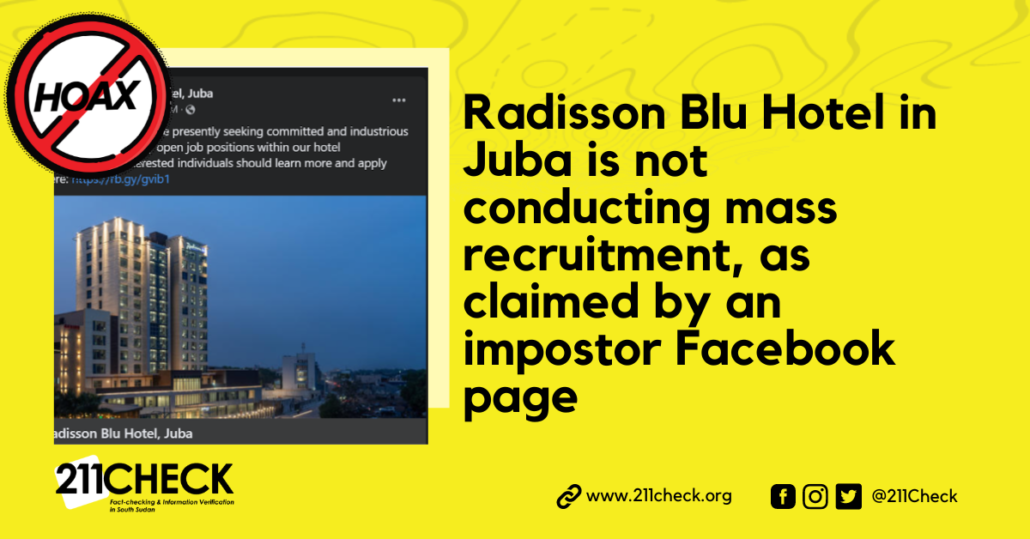
A Facebook page job advertisement that claimed to be from Radisson Blu Hotel, Juba, is a hoax by fraudsters.

The job advertisement, posted on the 28th of August 2023, claimed to offer more than ten different positions using a designed Google application form.

“We are presently seeking committed and industrious individuals to occupy open job positions within our hotel established. Interested individuals should learn more and apply,” reads part of the statement posted alongside the link to the Google application form.

Screenshot of the recruitment scam as posted on Facebook

Suspicious activity:

The fraudulent Facebook page was created on the 27th of August, 2023, and on the 28th, posted about the availability of job vacancies at the hotel according to the page’s profile transparency. The page has no official contacts for email and phone numbers, including the website address, which is unusual for a business entity like the continental hotel.

The Google-designed form link, when clicked, unveils 14 available positions, which include stock controller, waiters/waitresses, receptionists, cleaners, drivers, Cooks, cashiers, accounts clerks, restaurant managers, pastry Chef, gardeners, masseuses, and laundry attendants.

The application form can be filled out using an applicant’s full name, ID number, phone number, email address, gender category, level of education, position, current employment status, work experience, and references before submitting.

Verification:

211 Check reached out to the management of Radisson Blu Hotel Juba via email for inquiry and verification to ascertain the authenticity of the Facebook page job advertisement. However, it turned out that the job advertisement was a scam and fraudulent.

“We are seriously following up on this matter. We have also made [an] announcement to create awareness to the public at large on the ongoing recruitment scam and fraudulent activity,” reads an email correspondent from the management of Radisson Blu Hotel Juba to 211 Check.

“It has come to our attention that there is an ongoing recruitment scam…claiming to represent Radisson Blu Juba, promising job opportunities at our hotel. The safety and security of our community are of utmost importance to us. We want to assure all our valued followers that this is fraudulent activity, and we are taking immediate action to address the situation,” said Radisson Blu Hotel Juba in a statement it made to the public and was also shared with 211 Check.

The Radisson Blu Juba statement was made public to denounce the fake job advert

Findings:

There is no such advert on the website of the Radisson Blu Hotel Juba, and the social media platforms of the hotel have no advertisement of different positions as the Fake Facebook page claimed.

Conclusion:

211 Check finds that the Facebook page job advert claiming to represent Radisson Blu Hotel Juba is a scam designed by fraudsters to collect their personal information. 

Radisson Blu Hotel Juba management confirmed to 211 Check in an email that the Facebook job advert was not from their institution but a “recruitment scam and fraudulent activity.”

To ensure accuracy and transparency, we at 211 Check welcome corrections from our readers. If you spot an error in this article, please request a correction using this form. Our team will review your request and make the necessary corrections immediately, if any.

It’s vital to fight misinformation and disinformation in the media by avoiding fake news. Don’t share content you’re uncertain about. False information can harm and mislead people, risking their lives—Fact-check before sharing. For more details, visit https://211check.org/ or message us on WhatsApp at +211 917 298 255. #FactsMatter.
Fact check: Impostor USAID South Sudan Facebook page scamming individuals

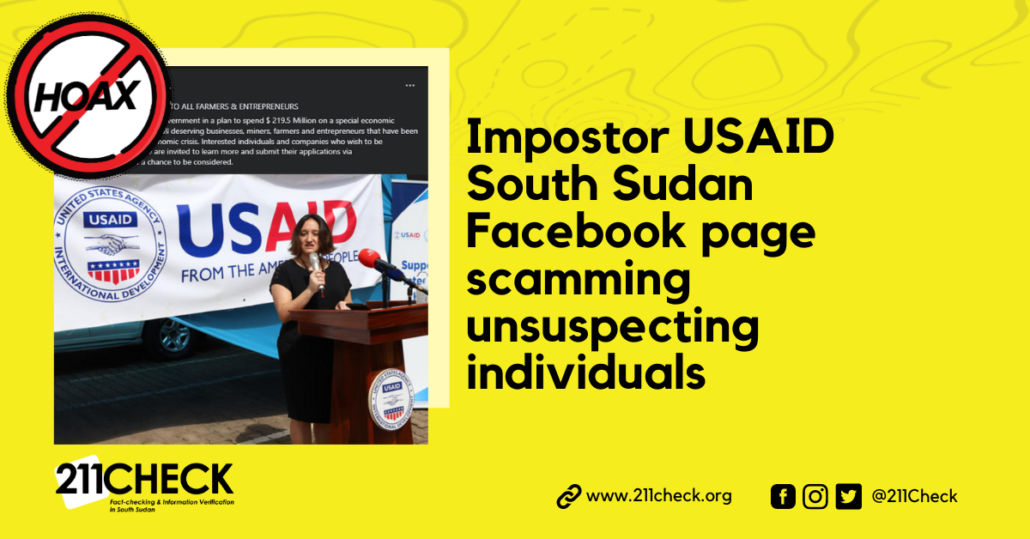
A Facebook page impersonating USAID South Sudan falsely claims to partner with the South Sudan government for economic support, but the page is a recent creation and a hoax aimed at soliciting applications from unsuspecting users.

Writer: Nancy Ceasar

A Facebook page impersonating USAID South Sudan claims it has partnered with the South Sudan government to support deserving businesses and individuals, but this is a hoax.

The page, which had 18 likes and 104 followers when writing this publication, was created on August 21, 2023, and uses the same cover photo of a lady in a vegetable garden as the original USAID South Sudan Facebook page. 

The imposter page has been running this advertisement claiming to offer opportunities to South Sudanese organisations and showing previous opportunities and beneficiaries of the activities they claim to have done.

We have partnered with the Government in a plan to spend $ 219.5 Million on a special economic stimulus program to support all deserving businesses, miners, farmers and entrepreneurs that the current global economic crisis has hit,” the post reads in part.

This Google Form Application is then attached to the post.

A screenshot of the sponsored Facebook post

A screenshot of the impostor’s page cover

A screenshot of the page transparency section shows when it was created.

Investigation:

On making comparisons, 211 Check realised significant differences between the two pages. USAID South Sudan, the original page was created on July 8, 2011, and is verified with a blue tick. Contrary to the fake page, the page also describes itself as a government organisation with 31,000 followers.

We discovered that the USAID South Sudan Facebook page is verified with a blue tick. it was created on July 8, 2011, and the page has 31k followers and 54 followers.

Screenshot of the legitimate USAID South Sudan Facebook page

USAID South Sudan shares legitimate opportunities on its social media accounts and website.

Conclusion:

211 Check, after a thorough look, concludes that the claim on an impostor Facebook page of USAID South Sudan that it is offering support to businesses and individuals is a hoax. The page running a sponsored post was recently created to solicit applications from unsuspecting Facebook users.

To ensure accuracy and transparency, we at 211 Check welcome corrections from our readers. If you spot an error in this article, please request a correction using this form. Our team will review your request and make the necessary corrections immediately, if any.


It’s vital to fight misinformation and disinformation in the media by avoiding fake news. Don’t share content you’re uncertain about. False information can harm and mislead people, risking their lives—Fact-check before sharing. For more details, visit https://211check.org/ or message us on WhatsApp at +211 917 298 255. #FactsMatter.

Fact-check: RwandAir isn’t offering government transport subsidies

RwandAir is not giving transport subsidies to citizens. This claim was made to trick unsuspecting internet users and take their sensitive information.

Writer: Nancy Ceasar

A message was forwarded to many  WhatsApp groups and private chats claiming to be Rwanda’s government transport subsidy, giving gifts to their lucky winners with an award of “$1,000,00” after answering some questions.

This is the screenshot of the process shown after answering the questionnaire provided by the link

Then after opening the box, it takes it to another unrelated site, making it suspicious. 

The picture on the congratulatory message was used by the Facebook page Rwanda, the heart of Africa, with the caption, “The national carrier, Rwanda, has been named among the most improved airlines in the world. Kigali international airport has also recorded the best-ever passenger traffic #I love Rwanda. Rwanda is a small country with a big dream,” on December 10th 2018.

Investigation:

211 Check carried out an examination of the URL using Virustotal, an online tool used to detect malware and other suspicious software. It detected the URL as being a phishing link. Phishing links are links created to promote scams or fraudulent activities, and by clicking on them, one’s information can be stolen and used for selfish reasons or to misuse information for personal gain.

The official website for RwandAir is: https://www.rwandair.com/ 

In addition, a Google Lens search shows that Pulse used the picture live.co.ke with the caption, “Here is how many passengers the top 10 African airlines managed to airlift in 2018.”

A screenshot of when Pulse first used the image 

Rwanda Airlines began operating on December 1, 2002, as a new national carrier under the name RwandAir Express [passenger air transportation is the core activity]. Rwanda, with concession, is carrying out airport ground handling ancillary activity at Kigali International Airport.

In March 2009, it was registered with a new trademark, RwandAir, the current operating name. The Rwandan government introduced a 29.3 billion Rwandan franc subsidy to ease the burden on pressed public transport service providers. Information provided by ODA indicates that the government has allocated a subsidy of 29.3 billion Rwandan Francs in the 2021 financial year as a relief payment to hard-pressed public transport operators. Under the now extended covid 19 regulations, Rwandan public transport operators are requested to reduce their load factors to 50% of carrying capacity.

Previously, the same claim had surfaced on the internet and was fact-checked by PesaCheck, as seen in this link.

Conclusion:

211 Check finds that the circular in WhatsApp groups claiming that the government of Rwanda will issue transportation subsidies and every citizen can get them is false. This is a phishing scam where some individuals collect internet users’ details and use them for their interests or sell them to a third party. The general public should be cautious when dealing with information online. Some information is too good to be true, and verification is needed before trusting any link shared on social media.

To ensure accuracy and transparency, we at 211 Check welcome corrections from our readers. If you spot an error in this article, please request a correction using this form. Our team will review your request and make the necessary corrections immediately, if any.

Fighting misinformation and disinformation in the media is crucial to avoiding fake news. Don’t share content you’re uncertain about. False information can harm and mislead people, risking their lives. Fact-check before sharing. For more details, visit https://211check.org/ or message us on WhatsApp at +211 917 298 255. #FactsMatter

HOAX: This website offering free 50GB data to celebrate WhatsApp’s 10th anniversary is a scam

The website is fake since WhatsApp’s 10th anniversary was celebrated in 2019

Writer: PesaCheck

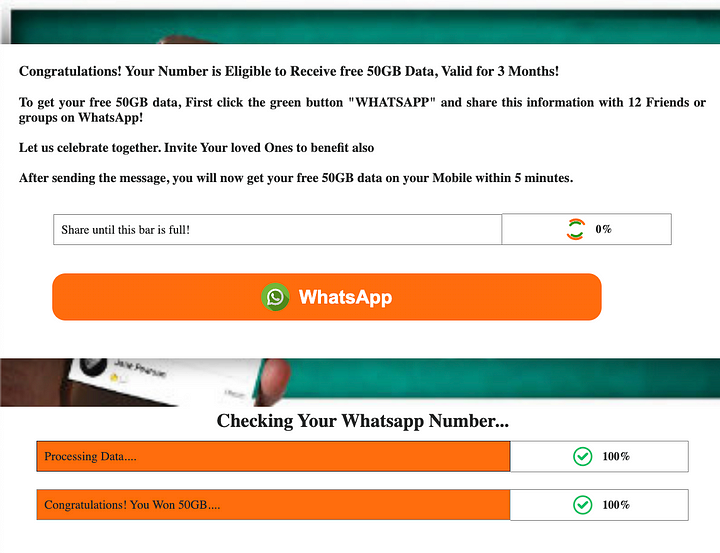
This website submitted for fact-checking via PesaCheck’s WhatsApp Tipline, supposedly offering WhatsApp users 50GB of data as part of the company’s 10th anniversary, is a HOAX.

To get the purported data, participants are required to provide their phone numbers and share the link with 12 friends or in WhatsApp groups.

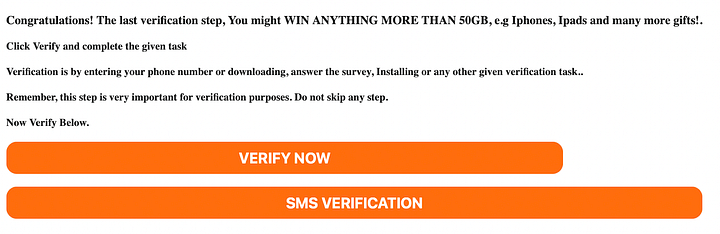
The website has several red flags, among them a suspicious URL, a request for personal details (phone number), and the requirement for users to share the link before receiving data. The red flags prompted us to investigate the website.

Despite PesaCheck following all the steps outlined in the alleged promotion, we did not receive the promised free data. In the final stage, the verification tab was unresponsive and repeatedly redirected us to unrelated web pages.

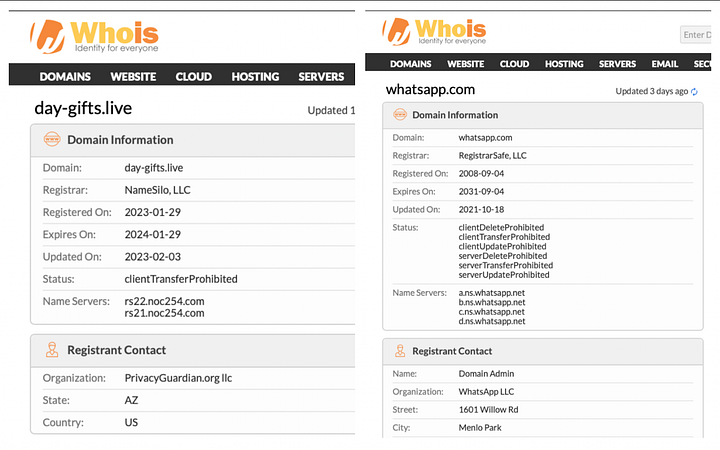
Additionally, we performed a Whois search and established that the website was registered on 29 January 2023, while the authentic WhatsApp website, Whatsapp.com, was registered in September 2008.

Legitimate sites are usually older than hoax sites. Bogus sites also tend to have concealed registrant details.

From left to right: a WHOIS search for the imposter vs that of the legitimate WhatsApp site.

The website claims that the free data is in celebration of WhatsApp’s 10th anniversary. However, the instant messaging application was founded in 2009 and celebrated its 10th anniversary in 2019.

On WhatsApp’s verified Twitter account and Facebook page, there’s no information on any such promotion.

PesaCheck examined a website submitted for fact-checking via PesaCheck’s WhatsApp Tipline, supposedly offering WhatsApp users 50GB of data as part of the company’s 10th anniversary celebration and found it to be a HOAX.

This fact check was published by 211 Check with support from Code for Africa’s PesaCheck and the African Fact-Checking Alliance.

To ensure accuracy and transparency, we at 211 Check welcome corrections from our readers. If you spot an error in this article, please request a correction using this form. Our team will review your request and make the necessary corrections immediately, if any.

It’s important to fight misinformation and disinformation in the media by avoiding fake news. Don’t share content you’re uncertain about. False information can harm and mislead people, risking their lives. Fact-check before sharing. For more details, visit https://211check.org/ or message us on WhatsApp at +211 917 298 255. #FactsMatter.

Explainer: Is the consumption of sugar-sweetened beverages harmful to human health?

Writer:  Ochaya Jackson

A video shared on Facebook on December 15th, 2022, and still making the rounds on social media, claims that Coca-Cola, which is one of the sugar-sweetened beverages, is not fit for the human body.

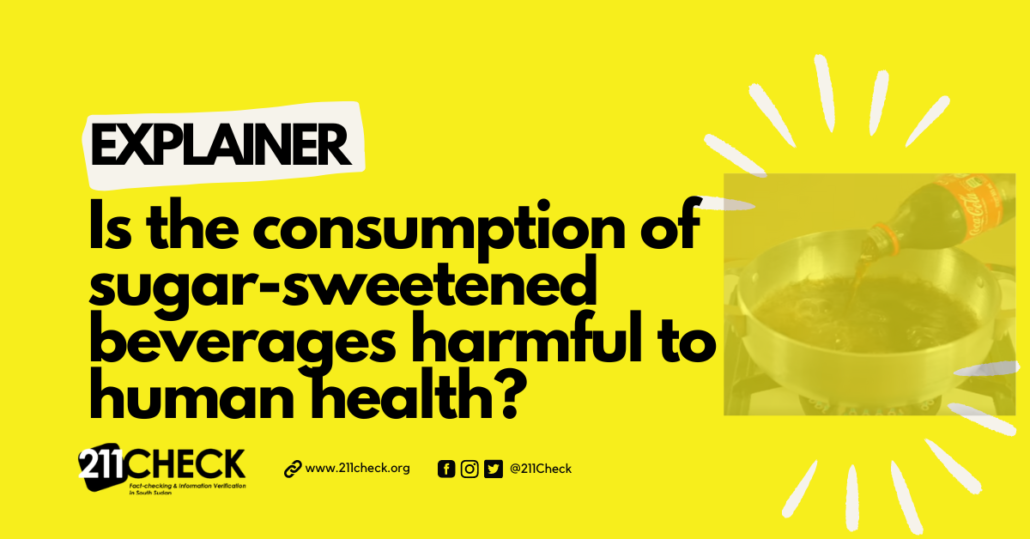
The three-minute video shows a Coca-Cola drink being poured into a saucepan and is accompanied by text that reads: “I will never buy Coca-Cola again. I discovered the secret.”

The screenshot of the heating stove while Coca-Cola drink is being poured

The video features a female voice narration demonstrating the effects of heating Coca-Cola on a hot stove in a saucepan. The narrator warns people not to drink Coca-Cola while raising questions about its chemical composition. 

The video alleges that Coca-Cola contains sugar and other harmful chemicals for the body. However, it does not specify the exact nature of these chemicals in Coca-Cola drinks.

“Don’t take this. Do you know that you are in danger by taking it? I’m going to show you now why you can not take it. Look now, I’m going to put about two bottles in a pot, and I will show you the danger you are running. People often do not know what they are taking. What is really the composition of Coca-cola? This drink has its chemistry. It is not really good for [the] human body. When you take it you feel your blood pressure rise,” the female’s voice explanation about the Coca-Cola drink on the video claimed. Four people die of diabetes. It is something very dangerous. The whole world knows that the sugar level is very high. It does more damage to your health,” the narrator claims.  

Additionally, the video suggests Kappa Tea as a healthier alternative, emphasising that it is produced ‘without sugar’.

Coca-Cola falls under sugar-sweetened/carbonated beverages, along with other sodas with added sugar.

Investigation:

211 Check researched on Coca-Cola drinks and other sugar-sweetened beverages, using publicly available data or literature on beverage drinks; and it gathered that excessive consumption of such drinks is unhealthy for the human body.

A study published in 2015 by the U.S.-based National Institute of Health, estimated that 184,000 people globally died due to sugary drink consumption. 

“Worldwide, the model estimated 184,000 deaths/year attributable to Sugar Sweetened Beverages (SSB) consumption: 133,000 (126,000–139,000) from diabetes, 45,000 (26,000–61,000) from cardiovascular diseases, and 6,450 (4,300–8,600) from cancers. 5.0% of SSB-related deaths occurred in low-income, 70.9% in middle-income, and 24.1% in high-income countries,” indicates the study. 

Similarly, a 2016 study on rats examined the effects of Coca-Cola consumption on rodents and found that those who consumed the beverage developed kidney and liver malfunctions compared to rats that did not drink it. Notably, the study emphasized the need for further research to confirm whether these effects extend to humans.

Likewise, in 2018, the National Institute of Health published a literature review detailing the impact of sugary drinks on the brain. The review revealed that sugar-sweetened beverages increase the risk of stroke and dementia due to the compounds and chemicals they contain.

According to Medical News Today, regular consumption of sugary drinks can increase blood sugar levels and affect the brain’s pleasure centres in a manner similar to heroin. There is also a confirmed link between sugary drinks and diabetes and their adverse effects on kidney and liver activity.

However, the report suggests that moderate consumption of Coca-Cola and sugar-sweetened beverages has only a minimal impact on human health.

Meanwhile, Coca-Cola Australia, in one of its advisories, acknowledges that many of its beverages contain sugar and that moderate consumption is considered healthy. Nevertheless, excessive consumption is not advisable for human health.

Many of our beverages contain sugar, which has kilojoules. While sugar is fine in moderation, too much of it isn’t good for anyone. Consuming too many kilojoules, including soft drinks with sugar, can contribute to weight gain,” it said on its website.

Further, Coca-Cola recommends a maximum of 150 milligrams per day, which, according to Mathaauditor and Flightpedia, equals 0.15 millitters. 

Fact-sheet

In 2015, the World Health Organisation (WHO) updated its guidelines on free sugar intake, recommending less than 10% of total daily energy consumption for adults and children. It further conditionally suggested reducing free sugar intake to less than 5%, equivalent to 25 grams (6 teaspoons) per day, for better health.

Free sugars include those added to foods and drinks by manufacturers, cooks, or consumers and sugars naturally present in honey, syrups, and fruit juice concentrates. A single can of sugar-sweetened soda contains up to 40 grams (around ten teaspoons) of free sugar, according to the WHO.

According to a 2022 report by the Centers For Disease Control and Prevention, frequent consumption of sugar-sweetened beverages is linked to weight gain, obesity, type 2 diabetes, heart disease, kidney diseases, non-alcoholic liver disease, tooth decay, cavities, gout, and arthritis. To maintain a healthy weight and dietary pattern, individuals are advised to limit their intake of sugary drinks.

Conclusion:

Research shows that excessive consumption of Coca-Cola or other sugar-sweetened beverages may harm human health, and moderate consumption is therefore advisable.

To maintain good health and a healthy weight, individuals should consume these drinks moderately to reduce the risk of developing diseases such as diabetes, cancer, cardiovascular issues, kidney disease, heart disease, liver disease, obesity, and related illnesses.

This fact check was published by 211 Check with support from Code for Africa’s PesaCheck and African Fact-Checking Alliance.

To ensure accuracy and transparency, we at 211 Check welcome corrections from our readers. If you spot an error in this article, please request a correction using this form. Our team will review your request and make the necessary corrections immediately, if any.

It’s vital to fight misinformation and disinformation in the media by avoiding fake news. Don’t share content you’re uncertain about. False information can harm and mislead people, risking lives—Fact-check before sharing. For more details, visit https://211check.org/ or message us on WhatsApp at +211 917 298 255. #FactsMatter 

Fact-check: No evidence low sugar intake, hot lemon juice and organic coconut oil can cure cancer

There is no scientific evidence that supports the claim. 

Writer: Beatrice Amude Paulino 

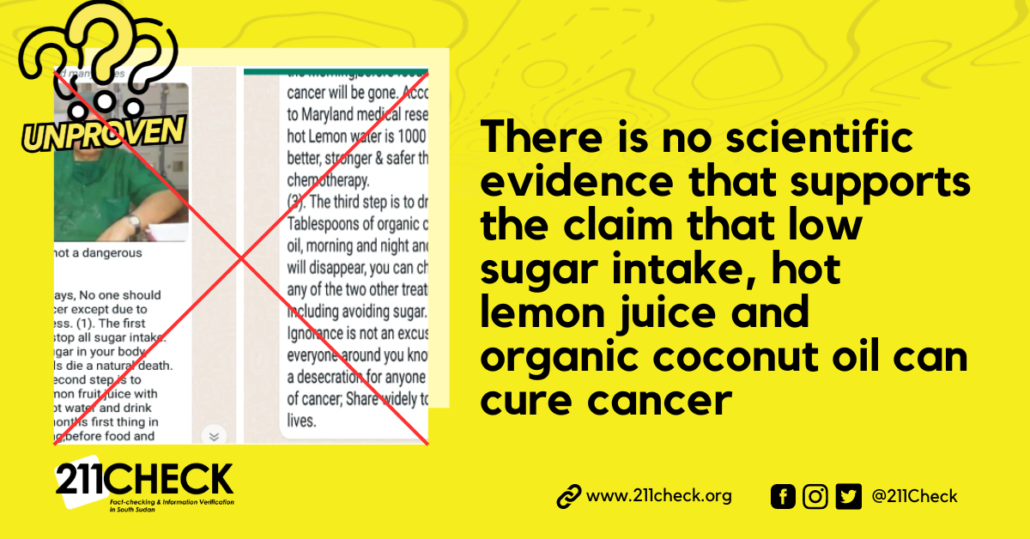
A message circulating on WhatsApp claims that a ‘Dr. Gupta’ says: “No one should die of cancer except due to carelessness.”

The message also lists some steps to back up the statement: The first step is to stop all sugar intake; without sugar in your body, cancer cells can die naturally. The second step is to drink hot lemon juice for three months before eating food, and the third step is to drink three tablespoons of coconut oil morning and night.

The claim, which has also been shared here on Facebook,  adds that the steps will eliminate cancer cells in the body.

Screenshot of the claims as shared on WhatsApp (2).

No, stopping sugar intake cannot kill cancer:

211 Check investigated the claim and discovered that, according to the US National Cancer Institute, cancer cells usually multiply quickly, which takes a lot of energy. The primary energy source in our bodies is glucose, which comes from sugar. Cancer cells also need lots of nutrients such as fats and amino acids. 

“Cancer cells, like all cells, require nourishment to flourish. Sugar is a significant fuel source but is far from the only one cancer needs,” says Memorial Sloan Kettering Cancer Center (MSK), a US-based research institute.

Can drinking hot lemon juice for three months cure cancer?

In the second step, the claim stated that hot lemon juice for three months could cure cancer.

Cancer Research UK, a registered charity that provides cancer information to the public, says that lemons contain properties like pectin, which, when modified, is an alternative therapy. 

Still, according to the National Center for Health Research, lemons are not proven or considered a remedy for fighting any type of cancer. No studies have been done to compare the effectiveness of lemon juice to chemotherapy. 

Can taking three tablespoons of organic coconut oil morning and night cure cancer?

The third step claims that taking three tablespoons of organic coconut oil morning and night will make the cancer ‘disappear’. The claim doesn’t specify how long this should be done.

The Harvard School of Public Health says that although coconut oil has many health benefits, they are tied to oil with a special formulation made of 100% medium-chain triglycerides (MCTs), which is not available in coconut oil usually found in commercial stores. Also, coconut oil mainly contains lauric acid, which is not an MCT but has been found to inhibit the growth of colon cancer cells. However, it is not established as a cure. 

Furthermore, the  World Health Organization(WHO) fact sheet has not mentioned any scientific proof supporting lemon, a sugar-free diet, or organic coconut oil curing cancer.

211 Check also found debunks by Africa Check, Full Fact, and Factly, which disputed the claims and the doctor.

Conclusion:

211 Check finds the claim that hot lemon water, sugar-free diets, and organic coconut oil can cure cancer unproven. The claim is a long-running social media hoax, and no scientific data or studies have shown that lemon, a sugar-free diet, and organic coconut oil can cure cancer.

This fact check was published by 211 Check with support from Code for Africa’s PesaCheck and African Fact-Checking Alliance.

To ensure accuracy and transparency, we at 211 Check welcome corrections from our readers. If you spot an error in this article, please request a correction using this form. Our team will review your request and make the necessary corrections immediately, if any.It’s vital to fight misinformation and disinformation in the media by avoiding fake news. Don’t share content you’re uncertain about. False information can harm and mislead people, risking lives—Fact-check before sharing. For more details, visit https://211check.org/ or message us on WhatsApp at +211 917 298 255. #FactsMatter

Fact-check: No, “Gammora” does not cure HIV/AIDS. It’s not a licenced medication

No, there is no cure for HIV/AIDS. It can, however, be managed using antiretroviral drugs, which stop the virus from replicating in the patient’s body.

Writer: Beatrice Amude Paulino

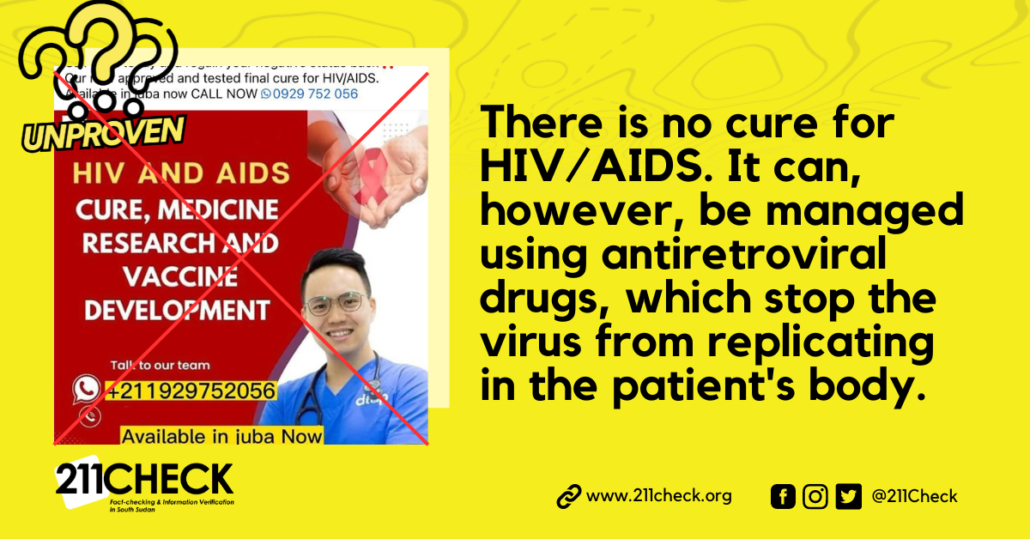
A Facebook page claiming to offer a new, approved, and tested final cure for HIV/AIDS – “Gammora” in Juba, South Sudan, is unproven.

On June 30, 2023,  Dr Shamir Care shared a poster with a text that partially reads: “GET a Kit today and regain your negative status back… Our new approved and tested final cure for HIV/AIDS...”  

The sponsored poster claims the service is available in Juba and directs interested people to talk to their team through a WhatsApp number linked to the post.

Screenshot of the poster as it appears on Facebook.

The post’s author then responds to enquiries about testimonies and physical location by asking them to reach out to the number provided, which raises suspicion.

The author can be seen replying to Facebook comments.

Other social media users, such as  Peter Garang Ngor Ayok, warned people about the advert in a published Facebook post. “The social media advert about HIV/AIDS cure circulating is malicious and meant to scam the people of South Sudan,” reads part of his post.

Investigation:

When contacted by 211 Check via WhatsApp, Dr Shamir Care responded that they offer tablets and injections in cash on a delivery basis. They do not have a physical location.

‘’You can buy tablets at 300$ It depends on which one you can afford, and all cures completely without the virus returning to your body… The brand name is Gammora, and it is available in Juba (sic).’’

A previous article in September 2022 by 211 Check established that Gammora does not cure HIV/AIDS.

Dr Leju Benjamin Modi, HIV Testing Services (HTS) Optimisation Advisor in the PEPFAR-supported HIV Care and Treatment Program in South Sudan at the Ministry of Health, said in a WhatsApp message, “As a medic and based on available data, there is no cure for HIV/AIDS yet. South Sudan’s Ministry of Health has not approved the sale of such a cure in the country” when asked to comment.

In January last year, the South Sudan Drugs and Food Control Authority (DFA) said it would start clamping down on unauthorised individuals involved in the importation of drugs. Secretary General for the authority Mawien Atem Mawien said after a public outcry that some medicines were ineffective, advising people to get malaria treatment from certified health facilities.

211 Check also contacted Dr Thomas Taban, a medical practitioner at Juba Teaching Hospital who dismissed claims of an HIV cure. “The people claiming to be curing HIV are scammers,” said Taban in response to 211 Check.

The World Health Organization(WHO) says there is no cure for HIV/AIDS. It is, however, treated with antiretroviral drugs, which stop the virus from replicating in the body.

Antiretroviral Therapy (ART) does not cure HIV infection but allows a person’s immune system to get stronger,’’ reads WHO. 

Conclusion:

211 Check finds the claim of Gammora as a cure for HIV/AIDS unproven. There is currently no cure for HIV/AIDS, although there have been advancements in the search for a cure. HIV/AIDS can only be managed through ART, a lifelong treatment that suppresses the replication of HIV in the body. 

This fact check was published by 211 Check with support from Code for Africa’s PesaCheck and the African Fact-Checking Alliance.    

To ensure accuracy and transparency, we at 211 Check welcome corrections from our readers. If you spot an error in this article, please request a correction using this form. Our team will review your request and make the necessary corrections immediately, if any.

It’s vital to fight misinformation and disinformation in the media by avoiding fake news. Don’t share content you’re uncertain about. False information can harm and mislead people, risking their lives. Fact-check before sharing. For more details, visit https://211check.org/ or message us on WhatsApp at +211 917 298 255. #FactsMatter.

Fact-check: Anonymous Sudan Group, NOT South Sudanese hackers  

An unproven claim of “South Sudanese hackers” bringing down Kenya’s eCitizen platform amidst a series of cyberattacks targeting various government and private institutions, allegedly linked to the hacking group known as Anonymous Sudan

Writers: Jibi Moses, Ochaya Jackson and Emmanuel Bida

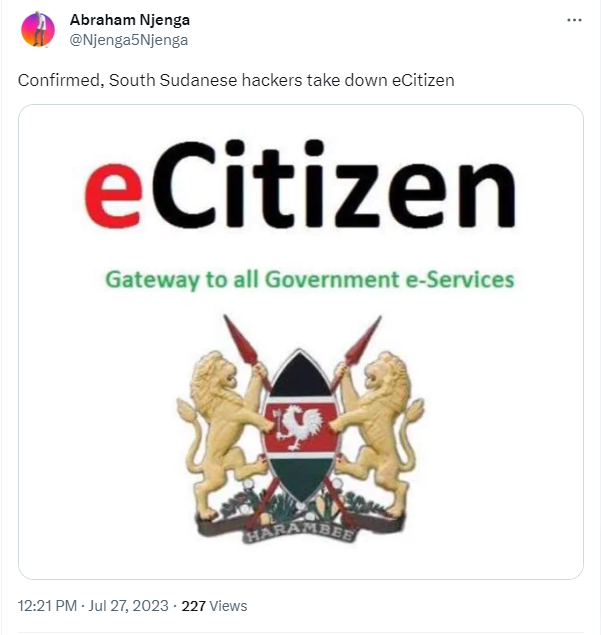
On July 27, 2023, a tweet claimed that “South Sudanese hackers” had brought down the Kenyan eCitizen platform, but this is unproven.

South Sudanese hackers bring down Kenya’s eCitizen platform, ICT Ministry Confirms,” the tweet reads.

The same claim, “South Sudanese hackers,” was repeated by other users on X here, here, and here.

A screenshot of the claim as posted on Twitter

The cyber attack on Kenya

Kenya’s cyberspace this week has been infiltrated by cyberattacks that targeted different government IT infrastructures, institutions, and private sectors. The attackers launched distributed denial-of-service (DDoS) attacks that overwhelmed various institutions’ Information Technology assets and rendered their services unavailable to the public.

On Thursday, the Kenyan government issued a statement acknowledging the attacks but saying the hackers failed to compromise the institutional IT infrastructure.

“Over the past week, unsuccessful cyberattack attempts have targeted the Government and private sectors. For clarity, the data’s privacy and security were not compromised. The system was not hacked,” reads the Kenyan government’s statement on Thursday.

The prime target of the attacks has been the Kenyan government’s e-Citizen Portal, which has most of the data from all government institutions. The Kenyan government noticed that the attacks disabled targeted systems and made them inaccessible. Still, the security architecture in place thwarted the attacker’s operations to take control of the target systems.

The relevant Government of Kenya agencies are on high alert and have enhanced the security of the e-Citizen portal and all Government Services Sites. All Systems and Portals under the control of the Government of Kenya are safe. The Government will continue its cyber-surveillance efforts and encourage the Public and Private sectors to heighten their cyber surveillance efforts so that jointly, we secure Kenya’s Cyberspace.

What is a DDoS attack?

A distributed denial of service (DDoS), according to Cloud Flare, is a malicious attempt to disrupt the regular traffic of a target server, service, or network by overwhelming the target or its surrounding infrastructure with a flood of internet traffic.

And CompTIA states that DDoS manipulates computer systems, properly works network equipment and services, exploits normal behaviour, and sniffs IT protocols to find vulnerabilities to penetrate its targets or victims. 211Check researched DDoS this year and wrote an explainer detailing its prevention or mitigation by an entity or individual.

Who claimed responsibility for the attack?

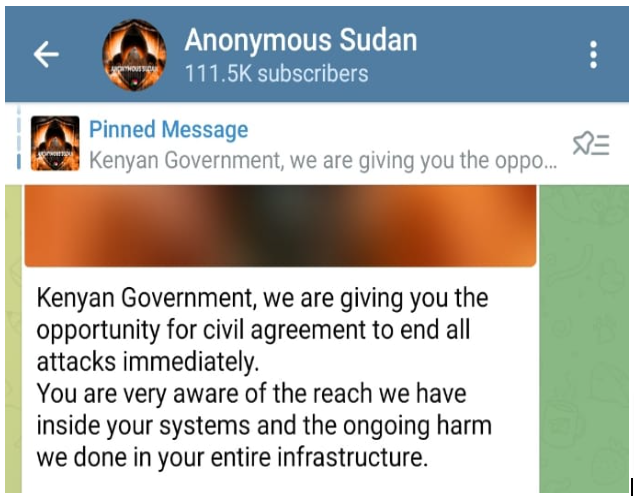
According to media reports, the cyberattacks on Kenya’s critical infrastructure have been linked to the hacking group that branded itself as Anonymous Sudan. The group has gained global prominence with attacks on critical government infrastructure in various countries worldwide.

A screenshot of the Anonymous Sudan Telegram Channel

Anonymous Sudan background

According to the ThreatMon report, Anonymous Sudan crippled various institutions through their attacks in Sweden, Denmark, France, Australia, and Germany. As the report indicated, the group is allegedly pro-Russia and targets government institutions, hospitals, and airport services of countries they believe to be against Sudan.

The report added that the hacking group started earlier this year, in 2023, after launching their Telegram Group with a proclamation to attack any country against Sudan.

The cyberattacks impact

This media report also details that the cyber attacks in Kenya targeted banks, telecommunication companies, media websites, university websites, hospitals, and transport agencies, which, according to the group, was retaliation against Kenya’s government because of its statement against Sudanese sovereignty.

The impact of the attack is being felt on the ground. Many mainstream services (such as rail and electricity tokens) rely on Mpesa payments and government services on eCitizen. This raises the question of our country’s level of preparedness, yet, it serves as a wake-up call for developing more resilient systems.” Dan Kingori, Kenyan Cybersecurity Engineer at Web for All, tells 211 Check.

There have been numerous theories on who is to blame. But it’s terrifying. Coincidentally, the Worldcoin rollout is taking place at this time.” he adds.

The attacks reportedly suspended over 5,000 public services for 48 hours and disrupted the financial payment (M-PESA) system. 

Conclusion 

211 Check finds the claim that South Sudanese hackers brought down the Kenyan government’s eCitizen platform unproven. Anonymous Sudan, a collective of hackers, has claimed responsibility for several Distributed-Denial of Service (DDoS) attacks on critical online services in Kenya.

To ensure accuracy and transparency, we at 211 Check welcome corrections from our readers. If you spot an error in this article, please request a correction using this form. Our team will review your request and make the necessary corrections immediately, if any.

It’s vital to fight misinformation and disinformation in the media by avoiding fake news. Don’t share content you’re uncertain about. False information can harm and mislead people, risking lives—Fact-check before sharing. For more details, visit https://211check.org/ or message us on WhatsApp at +211 917 298 255. #FactsMatter

Fact-check: Does this picture show parts of Juba?

No, this picture is of Khartoum, the capital of Sudan

Writer: Nancy Ceasar

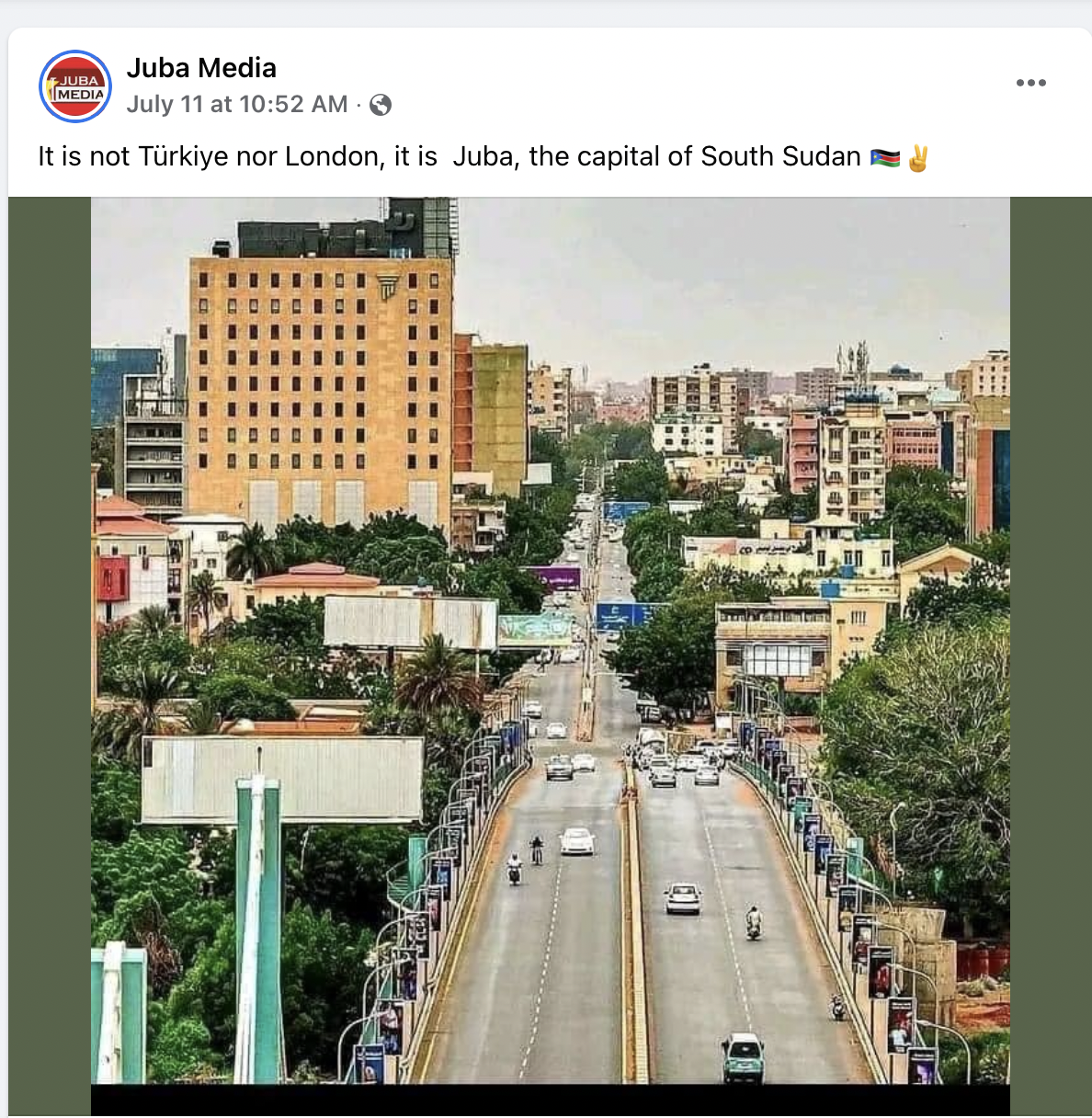
A picture of a highway and urban buildings shared on Facebook purporting to show parts of Juba, the capital of South Sudan, is misleading. 

This claim had attracted over 3000 interactions at the time of publishing.

This is the screenshot of the post. 

Investigation:

211 Check carried out a Google reverse image search on the picture, and the results showed that the picture has been used by different people in reference to Sudan in the past.

In one instance, a Facebook post with the same image encouraged the people of Sudan to preserve their country.

 “O my people in Sudan, O messengers of love, saints, pure righteous, this is your country; each piece of it belongs to your hearts; raise it high; this is your land, and you are its soldiers; do not let it get lost in your hands; every Arab and African in this existence is grateful to it, in its bows great grace, kneaded with the generosity of your hearts and generosity of your minds…” reads part of the post. 

The image was also shared on Twitter with a tweet that reads, in part:  

 “These are the people who live in Khartoum, for the people who drink morning tea with dumplings on Nile Street, next to Al Dayat or Central Station.  Bahri, for people who break their fast in Awadiya samak or wahhab or jamui foul fareed or Abdel wahhdah or Al shaeqi for lovers of prince Al shatby, Dodi, fwal al hijra…”

Further, SkyScraperCity, an online tabloid, on 17 September 2022 published an article with the title ‘Khartoum and Omdurman | Sudan | City Gallery’ where the image we are fact-checking was featured with the caption ‘Northern Sudanese.’

Sudan, whose capital is Khartoum, is officially known as the Republic of Sudan and borders the Red Sea to the north. It was the largest and one of Africa’s most geographically diverse states until it split into two countries in 2011, with South Sudan voting for independence.

On the other hand, South Sudan, whose capital is Juba, gained independence from Sudan on 9 July 2011, making it the most recent sovereign state or country with widespread recognition as of 2023. It includes the vast swamp region of the Sudd, formed by the white Nile, known locally as Bahr-al-Jebel, meaning “Mountain River. 

Conclusion:

211 Check has found that an image making rounds claiming to show Juba, South Sudan, is false and misleading. The picture is of Khartoum, the capital of Sudan.

This fact check was published by 211 Check with support from Code for Africa’s PesaCheck and African Fact-Checking Alliance.

To ensure accuracy and transparency, we at 211 Check welcome corrections from our readers. If you spot an error in this article, please request a correction using this form. Our team will review your request and make the necessary corrections immediately, if any.

It’s important to fight misinformation and disinformation in the media by avoiding fake news. Don’t share content you’re uncertain about. False information can harm and mislead people, risking lives—Fact-check before sharing. For more details, visit https://211check.org/ or message us on WhatsApp at +211 917 298 255. #FactsMatter

Fact-check: Was the Iranian President’s trip to Kenya cancelled?

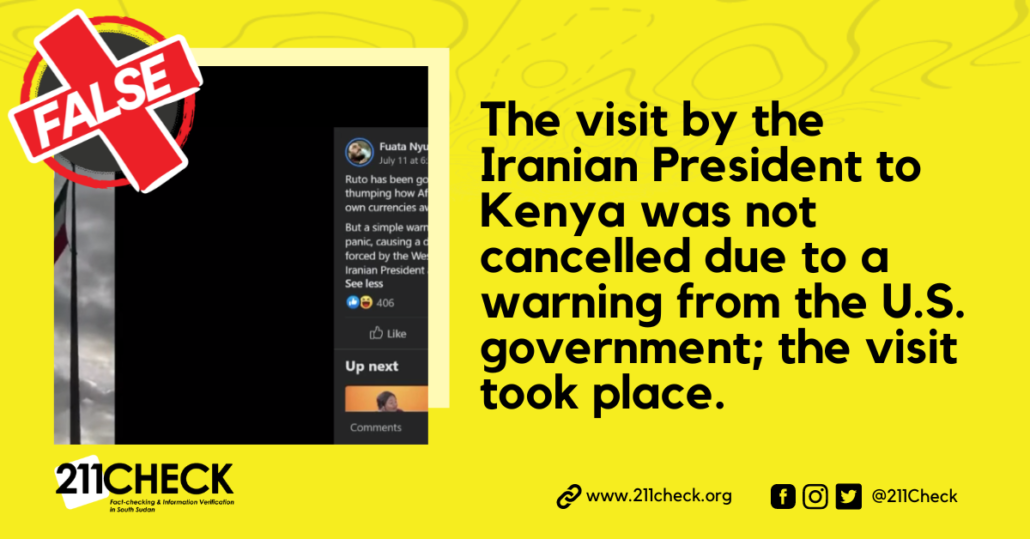
No, The visit by the Iranian President to Kenya was not cancelled due to a warning from the U.S. government; the visit took place, and both Kenyan and Iranian presidents signed memoranda of understanding to further the relationships.

Writer: Ochaya Jackson

A video shared on Facebook by Fuata Nyuki-Wa Kungu claiming that the Iranian President’s visit to Kenya was cancelled is false and misleading. The video, shared on 12 July 2023, contains narration and is accompanied by text stating that Kenya’s president, William Ruto, was panicking after the US warned him not to accord the Iranian president, Ebrahim Raisi, a state visit to Kenya.

“Ruto has been going all over Africa, chest thumping how Africans should be trading in their currencies away from the dollar. But a simple warning from [the] USA sends him in a panic, causing a diplomatic blunder, after he’s forced by the Western powers not to accord the Iranian President a State visit,” reads the post. 

The video’s narration transcript reads: 

“Imagine this, you are the president of Iran and you are about to embark on a historic tour of Africa, the first of by an Iranian leader in over a decade. You have been invited by the President of Kenya, who wants to boost trade and cooperation with your country. But then something goes wrong at the last minute, you are informed that your visit has been downgraded to an official visit meaning no state courtesies, no pomp and ceremony, no red carpet treatment. You are shocked and insulted by the sudden change of plans. You wonder what could have caused this snub. Is it pressure from the U.S. which imposed sanctions on your country? Is it fear of backlash from Israel which considers you a threat? Is it a sign of disrespect from Kenya which has closer ties with your rivals. You decided to cancel your visit and demand an explanation. You feel angry and betrayed by this diplomatic blunder. You wonder if Kenya is a reliable partner or puppet of the West. This is not a fictional scenario. This is what happened to Iranian President Ebrahim Raisi who was supposed to arrive in Kenya today for a state visit. Kenya’s Ministry of Foreign Affairs said the visit was rescheduled to allow finalisation of key MOUs that are central to the furtherance of relations. But sources say Kenya changed its mind due to certain reasons that have not been disclosed. Iran has cancelled the visit and is waiting for an apology from Kenya. A high level crisis meeting is currently ongoing at the state house trying to resolve the matter and find ways of convincing President Raisi to come to Kenya. What do you think about this situation? How do you feel about Kenya’s decision? How do you think Iran will react?” 

211 Check investigation: 

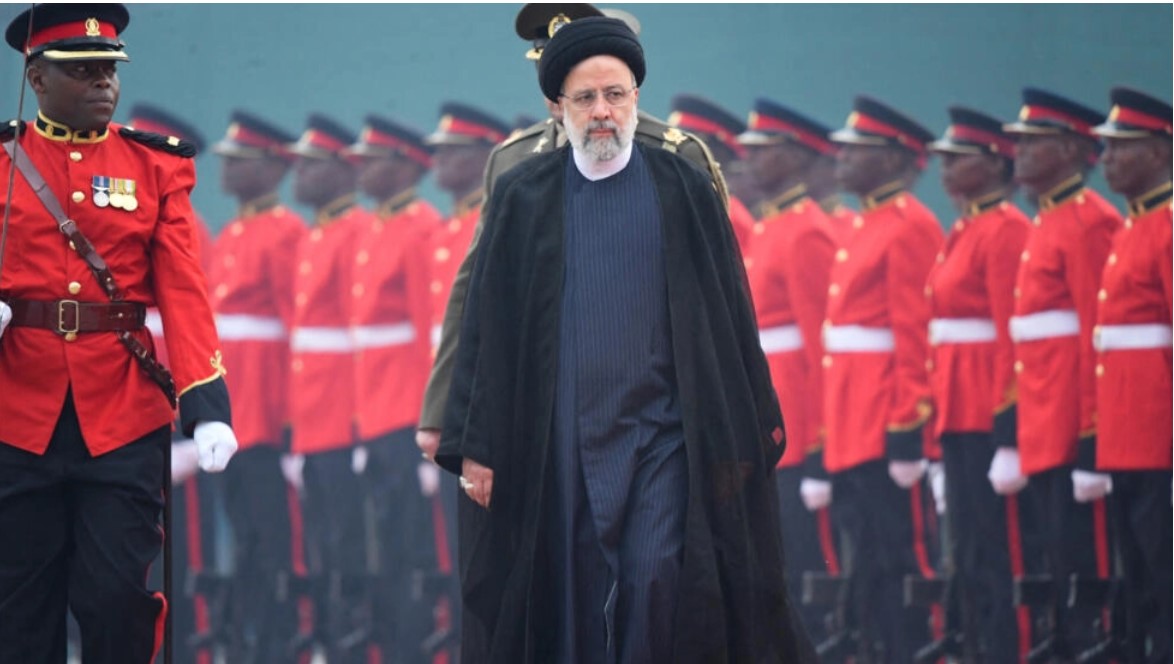
According to a media report reviewed by 211 Check, the Iranian President was welcomed with a red carpet in the Kenyan capital, Nairobi, on Wednesday, 12 July 2023.

Iran’s President Ebrahim Raisi inspects the guard of honour during his state visit at the State House in Nairobi on 12 July 2023. © AFP/Simon Maina

Additionally, according to a K24TV video tweet, the Kenyan President said his country had witnessed the signing of a memorandum of understanding on communication and information technology, fisheries, animal health, and livestock production with Raisi upon his visit to Kenya.

From left Iranian President Ebrahim Raisi, accompanied by Kenya President William Ruto (middle), courtesy K24 TV.
The visit was initially slated for Tuesday, 11 July 2023. Still, according to the Kenya Ministry of Foreign Affairs, as per the media report, it was rescheduled for Wednesday to give room for the finalisation memorandum of the understanding.

“The President of Iran, Ebrahim Raisi, was scheduled to arrive in the country for a visit today [Tuesday]. The visit allowed the two countries to review and re-energize their bilateral relations for the mutual benefit of the people of the two countries. The schedule of the President [of Iran, Ebrahim Raisi] has now been reviewed to allow for the finalisation of key MoUs central to further relations. The Iranian President will now arrive tomorrow [Wednesday 12th, July 2023]  for a State Visit,” reads part of the Kenyan Ministry of Foreign Affairs statement as quoted by the media.

“The President will be at the State House at 7.00 am tomorrow [Wednesday] for a bilateral meeting. He will, after that, proceed to lay a wreath at the Mausoleum of the late Mzee Jomo Kenyatta before proceeding to tour other African countries,” the ministry added.

In addition to that, Dr. Alfred N. Mutua, the Kenyan Cabinet Secretary of Foreign and Diaspora Affairs, tweeted that President William Ruto held high-level bilateral talks with his counterpart, Iranian President Ebrahim Raisi and the five memoranda of understanding signed laid the basis for continued socio-economic cooperation.

The Iranian President’s tour to Africa also took him to Uganda and Zimbabwe.

Conclusion:

The visit by the Iranian President to Kenya was not cancelled due to a warning from the U.S. government; the visit took place, and both Kenyan and Iranian presidents signed memoranda of understanding to further the relationships between the two countries.

This fact check was published by 211 Check with support from Code for Africa’s PesaCheck and African Fact-Checking Alliance.

To ensure accuracy and transparency, we at 211 Check welcome corrections from our readers. If you spot an error in this article, please request a correction using this form. Our team will review your request and make the necessary corrections immediately, if any.

It’s important to fight misinformation and disinformation in media by avoiding fake news. Don’t share content you’re uncertain about. False information can harm and mislead people, risking lives—Fact-check before sharing. For more details, visit https://211check.org/ or message us on WhatsApp at +211 917 298 255. #FactsMatter