Debunking the Mosquito Coil Lung Disease Myth in South Sudan and Ghana (2016)

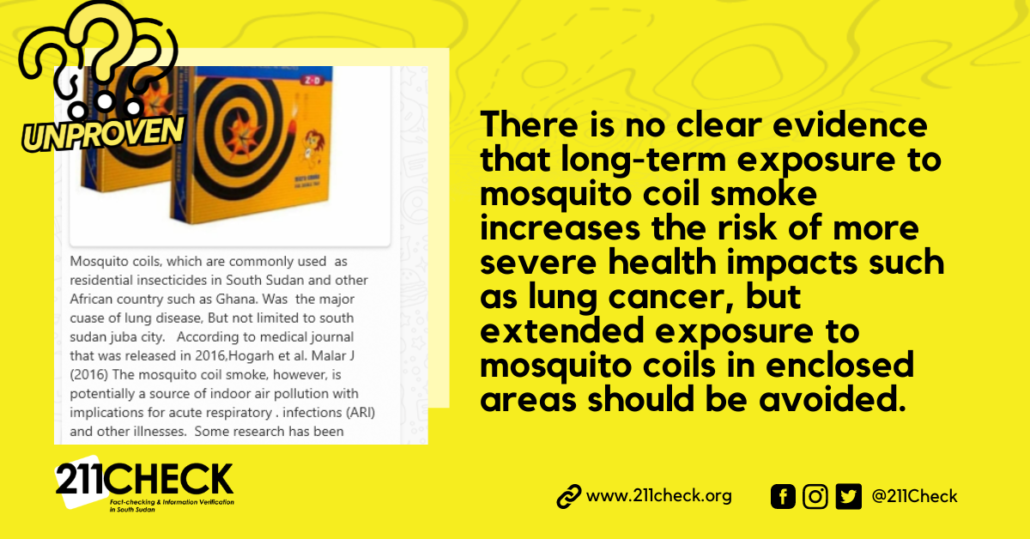
There is no clear evidence that long-term exposure to mosquito coil smoke increases the risk of more severe health impacts such as lung cancer, but extended exposure to mosquito coils in enclosed areas should be avoided.

Writer: Jibi Moses

A message claiming that mosquito coils are the common cause of lung cancer in South Sudan and Ghana, making the rounds in WhatsApp groups and private chats, is not supported by substantial evidence.

The message quotes a Medical Journal published in 2016 by Hogarth et al.—Malar, which says that mosquito coil smoke is a potential source of indoor infections and other diseases but did not mention lung cancer. The message, which has pictures of the Zenden brand of Mosquito coil, primarily talks about the dangers of the coil and how it is the leading cause of lung diseases in South Sudan and Ghana.

“Mosquito coils, commonly used as residential insecticides in South Sudan and other African Countries such as Ghana, were the major cause of Lung disease…,” partly reads the message.

The viral message further claims other studies done in Asia show that the insecticide has different chemicals, including chloromethyl, which, the article says, is a highly potent lung carcinogen that can be produced by thermolytic degradation. The content, however, does not have an author or a clear origin.

A screenshot of the circulating message on WhatsApp 

What do we know?

The author quotes the study in his or her article  Malaria  Journal by Jonathan Hogarth, published on February 4, 2016, in Ghana, under the heading Application of Mosquito Repellents, Coils, and Associating Health Issues in Ghana. The report was the final work of research to determine the effectiveness of mosquito coils and repellents and their associated impact. 

The research found that the insecticides were ineffective and posed a health danger but did not explicitly state that it is the cause of lung cancer in South Sudan and Ghana.

A report published by the National Library of Medicine in 2015 by JIE Zhang and others titled Mosquito coil exposure associated with small cell lung cancer: A report of three cases. A research report carried out in Asia on cancer patients was carried out on a few individuals who previously worked with a mosquito coil-producing company. The information admits insecticides have chloromethyl, a highly potent lung carcinogen. However, the report says the significance of exposure is uncertain.

“Mosquito coils, commonly used as residential insecticides in Asia, contain different concentrations of octachlorodipropyl ether (S-2) as a synergist or an active ingredient. As bis(chloromethyl) ether (BCME) is an extremely potent lung carcinogen that can be produced by the thermolytic degradation of S-2, contact with mosquito coils is likely to expose individuals to a certain level of BCME and therefore increase the risk of lung cancer. However, the significance of exposure is uncertain as clinical and epidemiological studies concerning mosquito coil users and workers are lacking….” 

The report concludes that contact with mosquito coils will likely expose individuals to a level of S-2 that may increase the risk of SCLC but does not concretely say mosquito coils cause cancer. 

What is lung cancer disease?

Penn Medicine defines lung cancer disease as any lung problem that prevents the lungs from working properly. World Health Organisation says The significant risk factors for chronic respiratory diseases include tobacco smoke and other indoor air pollution, allergens, household chemicals, and outdoor pollution. Some leading causes of lung diseases are explained here.

Conclusion:

211 Check finds the claim that mosquito coil is the leading cause of lung diseases unproven. Though the insecticide has some chloromethyl content, the World Health Organisation says tobacco is the leading cause of lung diseases.

In the face of this uncertainty, the essential lesson should be to avoid extended exposure to mosquito coils, particularly in enclosed areas, The Conversation says.

To ensure accuracy and transparency, we at 211 Check welcome corrections from our readers. If you spot an error in this article, please request a correction using this form. Our team will review your request and make the necessary corrections immediately, if any.

It is crucial to fight against misinformation and disinformation in mainstream and alternative media by avoiding becoming a victim of fake news. To prevent the spread of false information, you must refrain from sharing content you are unsure about or unaware of its origin. Disinformation and misinformation can be incredibly dangerous because they can mislead people and cause harm. For instance, false information on health matters can lead to wrong decisions that can put people’s lives at risk. Therefore, it’s vital to fact-check information before sharing it to promote accurate and reliable information. Visit https://211check.org/ for more details on our fact-checking process, or send us a WhatsApp message at +211 917 298 255 if you want to present a claim. Our team will promptly respond to your request because we believe #FactsMatter.

Fact-check: Viral WhatsApp message about 2023 recruitment at Total Energies is false

The messages on WhatsApp are scams embedded with malicious links intended to steal people’s helpful information. 

Writer: Jibi Moses

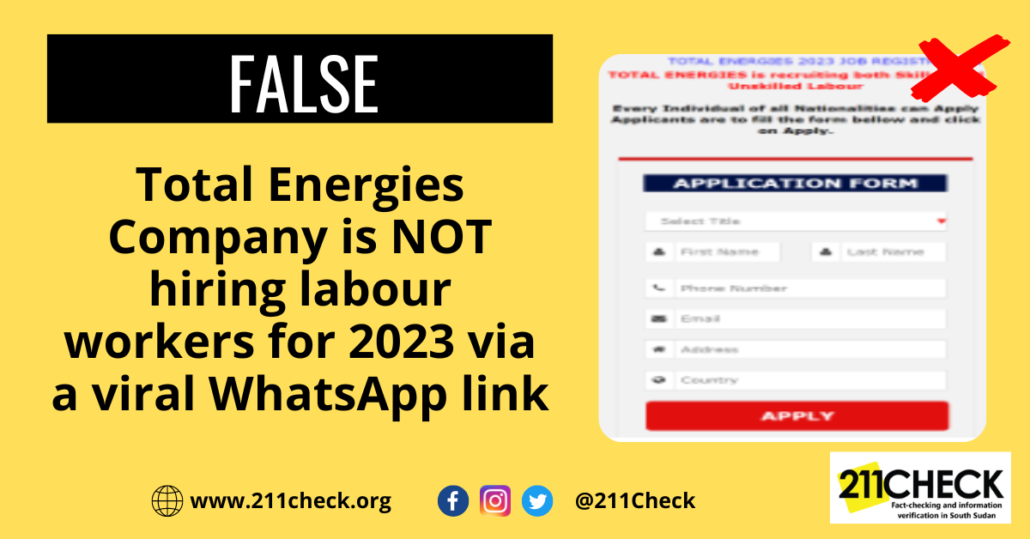
A message is making rounds on WhatsApp claiming Total Energies, one of the world’s leading petroleum business companies, is recruiting. This is false.

“GOOD NEWS!  TotalEnergies Oil and Gas company is recruiting both Skilled and Unskilled Labour with good Salary Payment. It is no longer news. APPLY NOW,” the message reads partially.

On clicking the job advertisement link, it looks too good to be true because it highly emphasizes that the company offers both skilled and unskilled labour. The application is too easy to fill out, and when one is done filling in his details, you are requested to share the link in five WhatsApp groups or over fifteen individuals to get the job.

A screenshot of the job advertisement on opening the link.

What have we found out?

211 Check investigated the advertisement by examining the link attached to the message. Results from one of the vendors on VirusTotal, an online tool used to detect malware and other suspicious wares, show that the connection is embedded with a Malicious URL. These are links created to promote scams or fraudulent activity. They are persuasive, intending to gain sensitive and personal information. Clicking on such links can lead to various consequences, from having your data stolen to being the victim of a cyberattack.

Total Energies is a French multinational integrated energy and petroleum company founded in 1924 and is one of the seven supermajor oil companies. Is Headquartered in  Courbevoie, France. With Subsidiaries of  TotalEnergies, Total Espana SA, SunPower, and MORE currently under the leadership of Patrick Pouyanné as the CEO, He assumed that position on 22 October 2014. 

The company was founded on March 28 March 1924, by  Ernest Mercier. As of 2020, it employs up to  105,476 people with a straightforward means of calling for applications through the Career section on their websites.

We ran the two links on Whois, an online tool that analyses websites and showed that the two links are entirely different. The Total Energies website was first registered in France in 2014 and updated in 2023. Meanwhile, the other link was first recorded in 2023 the United States in America. Earlier this year, a similar advert made rounds on the internet particularly WhatsApp and 211 Check, found it false.

A Screenshot of the Whois details of the Total Energies website as shown by whois.com

A screenshot of the malicious link is shown on whois.com.

Conclusion:

211 Check finds that the advert in WhatsApp groups and private chats claiming to be from Total Energies is false. These are scams embedded with Malicious links intended to steal people’s helpful information. We advise the public to be cautious when interacting with such social media posts and verify the authenticity of any claims before acting on them.

To ensure accuracy and transparency, we at 211 Check welcome corrections from our readers. If you spot an error in this article, please request a correction using this form. Our team will review your request and make the necessary corrections immediately, if any.

It is crucial to fight against misinformation and disinformation in mainstream and alternative media by avoiding becoming a victim of fake news. To prevent the spread of false information, you must refrain from sharing content you are unsure about or unaware of its origin. Disinformation and misinformation can be incredibly dangerous because they can mislead people and cause harm. For instance, false information on health matters can lead to wrong decisions that can put people’s lives at risk. Therefore, it’s vital to fact-check information before sharing it to promote accurate and reliable information. Visit https://211check.org/ for more details on our fact-checking process, or send us a WhatsApp message at +211 917 298 255 if you want to present a claim. Our team will promptly respond to your request because we believe #FactsMatter.

Explainer: What are internet cookies, and what are they used for? 

Internet cookies, small text files stored on devices, remember preferences, track activity, and enhance browsing. However, concerns about tracking and privacy exist, and users can accept or reject cookies based on convenience, personalization, and privacy preferences.

Writer: Steve Topua

Internet cookies, or HTTP cookies, are small text files stored on a user’s computer or device when they visit a website. These files contain data websites use to remember user preferences, track activity, and enhance the browsing experience. Websites create cookies and send them to a user’s web browser, where they are stored and sent back to the website each time the user revisits it.

History

The concept of internet cookies was introduced by Lou Montulli, a computer programmer, in 1994. Montulli worked at Netscape Communications Corporation (now known as Mozilla Corporation). He developed the original implementation of cookies to solve a problem related to managing online shopping carts.

Montulli’s invention of cookies was a significant milestone in web technology. It allowed websites to store small data on a user’s computer or device, enabling them to remember user preferences, maintain session information, and enhance the browsing experience.

Since their introduction, cookies have become an integral part of the web ecosystem, serving various functions for website functionality, personalisation, and analytics. They have evolved and been standardised over time, with different types and mechanisms for managing them implemented in web browsers and governed by privacy regulations.

Types of Cookies

Some of the types of cookies include:

  • Necessary cookies: a cookie the website uses to function correctly, without which the site would not work. This type of cookie does not collect any personally identifiable information about you and does not track your browsing habits.
  • Session Cookies: These cookies are temporary and are erased once the user closes their browser. They are primarily used to maintain a user’s session on a website, remembering actions and preferences during the visit. Session cookies are crucial in online shopping carts or maintaining logged-in states.
  • Persistent/permanent Cookies: Unlike session cookies, persistent cookies remain on a user’s device even after the browser is closed. They have an expiration date and can store information such as login details, language preferences, and personalised settings. Persistent cookies enable websites to recognise returning users and provide a more personalised experience.
  • Third-Party Cookies: Third-party cookies are created by domains other than the website a user is visiting. They are commonly used for advertising and tracking purposes, allowing advertisers to deliver targeted ads based on a user’s browsing history and behaviour across multiple websites.

Uses

The following are some of the uses of Internet Cookies:

  • Enhanced User Experience: Cookies enable websites to remember user preferences, making subsequent visits more personalised and efficient. They allow for features like saved login information, language preferences, and tailored content recommendations.
  • Shopping Convenience: Persistent cookies facilitate online shopping by storing items in a user’s cart even if they navigate away from the website. They also remember user details, simplifying the checkout process.
  • Website Analytics: Cookies provide valuable insights to website owners by collecting anonymous data on user behaviour. This data helps improve website performance, identify popular content, and optimise marketing strategies.

Concerns and Privacy Considerations:

While cookies offer numerous benefits, privacy and data security concerns have arisen. Some key considerations include

  • Tracking and Profiling: Third-party cookies can track users’ activities across multiple websites, leading to concerns about data privacy and online profiling. This has sparked debates about the balance between personalised experiences and individual privacy.
  • Security Risks: As cookies store information on a user’s device, there is a potential risk if malicious parties access them. However, modern web browsers have implemented safeguards to mitigate these risks.
  • Opt-Out Options: Recognizing the need for transparency and control, web browsers and privacy regulations allow users to manage and control cookie settings. Users can block or delete cookies or opt out of targeted advertising.

Should you Accept or Reject Internet Cookies?

We explore the benefits and challenges of each of the two options.

Accepting Cookies gives you the following advantages:

  • Buying cookies enables websites to remember your preferences and settings, such as language preferences, login information, and personalised content recommendations.  This often leads to a more customised and convenient browsing experience.
  • Cookies help websites remember your previous interactions, making it easier for you to navigate and interact with the site. For instance, if you add items to your shopping cart and accept cookies, the website can retain that information, even if you leave and return later.
  • Many website features and services rely on cookies to function correctly. Accepting cookies ensures that all website functionalities, such as forms, shopping carts, and user preferences, operate smoothly.

Rejecting Cookies ensures the following is achieved:

  • Enhanced Privacy: Rejecting cookies can provide a higher level of privacy as it limits the data that websites can collect about your browsing habits. This is particularly relevant for third-party cookies, often used for tracking and targeted advertising.
  • Limited Personalization: Without cookies, websites may be unable to remember your preferences or provide personalised experiences. You may need to enter login information manually, set language preferences, or customise settings each time you visit a site.
  • Disrupted Functionality: Some websites may rely heavily on cookies to provide certain functionalities. Rejecting cookies might reduce functionality, rendering certain features inaccessible or less convenient.

Managing Cookie Settings:

 Many web browsers offer more granular controls for managing cookie settings. These options include blocking third-party cookies and deleting cookies.

Ultimately, the decision to accept or reject cookies depends on your preferences regarding convenience, personalisation, and privacy. Reviewing and adjusting your cookie settings in your web browser to align with your desired level of privacy and browsing experience is advisable.

Can cookies be erased or blocked?

To erase cookies, you must find and delete the folder or file where they are stored on your device.

  • Session cookies will automatically be deleted when you close your web browser.
  • You can also block a website’s cookies by configuring your browser settings.
  • You can also use specialist software that protects against malicious cookies. These applications can be customised to let you change the content of the cookies you want to receive or allow to be stored on your device.

Cookie Wall and its implications:

According to cookiebot , a cookie wall is a practice where a website blocks access to its content or services unless the user consents to use cookies. In other words, it forces users to accept cookies to access the website’s full functionality. Cookie walls are often presented as pop-up overlays or banners that require users to click “Accept” or a similar option to proceed.

The use of cookie walls has been debated and has raised concerns regarding privacy and freedom of choice for users. Critics argue that cookie walls may create a situation where users feel coerced into accepting cookies, compromising their privacy rights. They say that users should be able to access a website’s content without being forced to consent to data collection through cookies.

Laws addressing Cookie Walls

The following are some laws that specifically address cookie walls. These laws protect user privacy and ensure consent is not obtained through coercion. They promote transparency and allow users to make informed choices about cookies and their data.

General Data Protection Regulation (GDPR)

The GDPR, which applies to the European Union (EU) and the European Economic Area (EEA), sets strict requirements for obtaining user consent. It requires all multinational companies to provide an opt-in whereby website owners receive a user’s permission to use cookies before storing them on a user’s web browsers. This opt-in is designed to give users greater control over their data, knowing the information is being collected if they consent to that data collection. It also emphasises that permission must be freely given, specific, informed, and unambiguous. GDPR explicitly states that consent is invalid if a user is forced to consent by a cookie wall. 

ePrivacy Directive

The ePrivacy Directive, or the “Cookie Law,” applies to EU member states and governs using cookies and similar technologies. It requires websites to obtain user consent before placing non-essential cookies, such as those used for tracking or advertising. The directive does not explicitly address cookie walls, but it emphasises the importance of user consent and transparency.

California Consumer Privacy Act (CCPA)

CCPA, a privacy law in California, gives consumers the right to opt out of selling their personal information. While it does not explicitly mention cookie walls, it provides users the right to refuse the sale of their personal information, which may include data collected through cookies.

Brazil’s General Data Protection Law (LGPD)

LGPD, Brazil’s data protection law, requires websites to obtain explicit user consent before processing data. While it does not explicitly mention cookie walls, it highlights the importance of freely given consent.

Website owners and operators must comply with relevant privacy laws and ensure their practices respect user rights and privacy preferences.

Sources:

  1. https://allaboutcookies.org/what-is-a-cookie 
  2. https://www.cloudflare.com/learning/privacy/what-are-cookies/#:~:text=Cookies%20are%20small%20files%20of,makes%20of%20the%20web%20server
  3. https://www.earthlink.net/blog/what-are-internet-cookies/ 

To ensure accuracy and transparency, we at 211 Check welcome corrections from our readers. If you spot an error in this article, please request a correction using this form. Our team will review your request and make the necessary corrections immediately, if any.
Fact-check: This recruitment exercise is not from NRA South Sudan

These scams use harmful and phishing URLs to steal valuable information from people. We tell people to be careful when responding to these social media posts and to check the truth of any claims before acting on them.

Writer: Jibi Moses

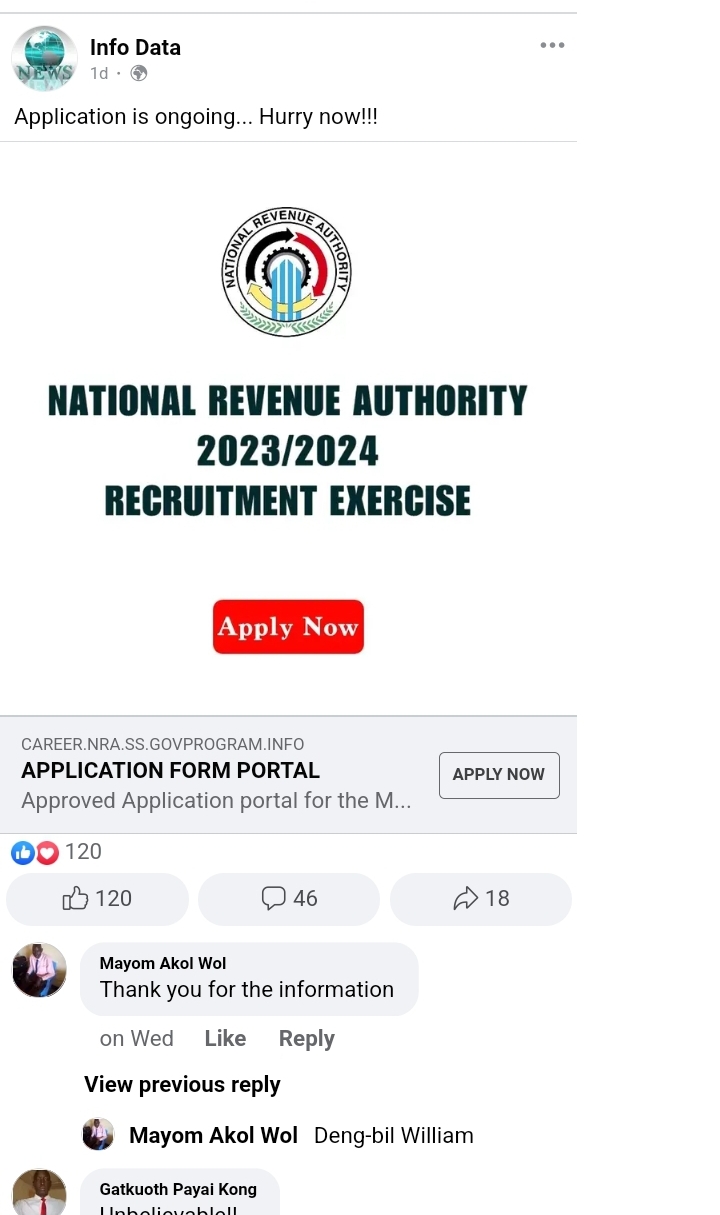
On 16th June 2023, a post on Facebook claimed that an application was ongoing for a recruitment exercise by the National Revenue Authority, also known as the NRA in South Sudan, but this is false.

The claim has also been shared with a link in WhatsApp groups and private chats by unsuspecting individuals.

Application is ongoing… hurry now!” partly reads a post on the little-known Info Data Facebook page. This post attracted over 120 reactions, 46 comments and 18 shares.

Screenshot of the Facebook post by Info Data. 

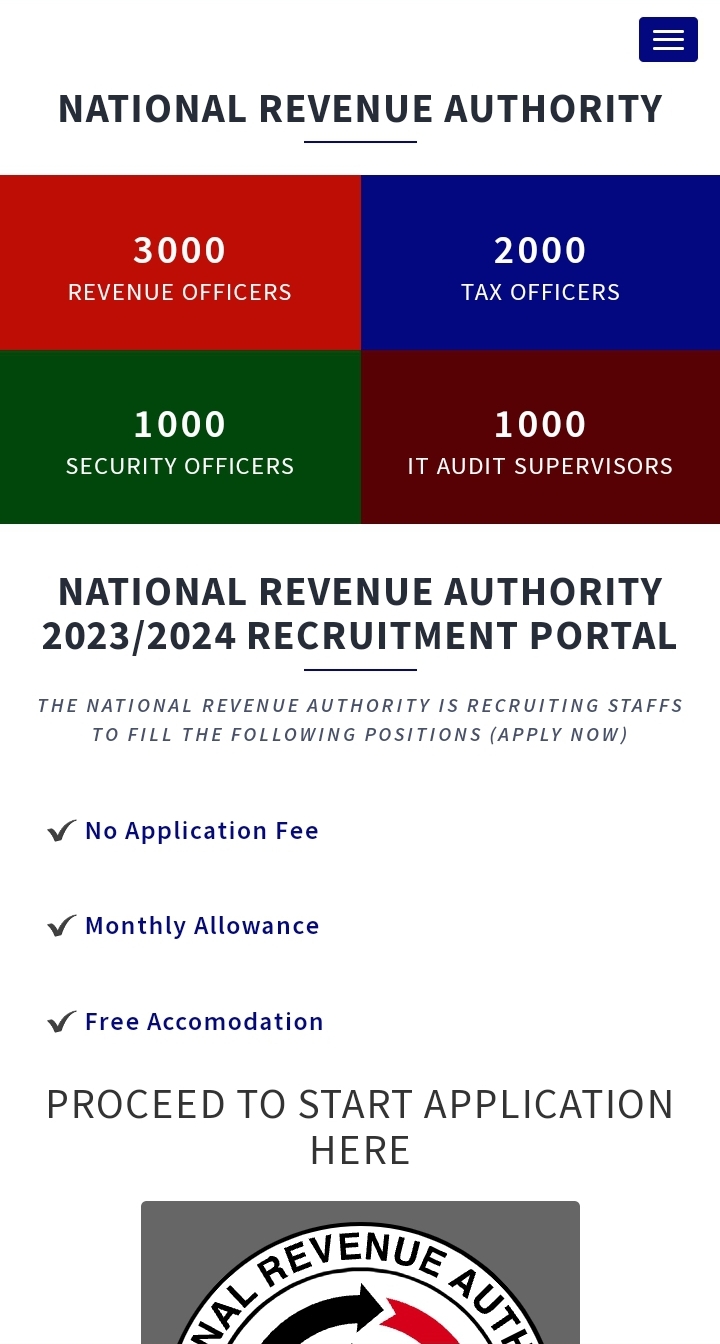
On clicking the link titled “APPLICATION FORM PORTAL,”  one is directed to a platform which claims to be for NRA, with classified jobs and the number of required applications. 

Screenshot of the first page of the link.

Opening the link on a protected gadget warns you not to continue the connection or risk giving your details. Strong anti-virus and Virtual Private Networks (VPNs) play a crucial role in protecting us while online.

The link later on demands one to give his name and phone number to get the job. However, after this stage, one is asked to share with at least 15 individuals or five WhatsApp groups. This process lets the malicious link spread so fast as unsuspecting persons think this is the best option to get the job. Unfortunately, at this stage, people’s details are extracted, or this is where we give out our details to scammers.

Further screening on Virustotal, two security vendors flagged the URL as a phishing link and some others as Malicious links.

A malicious URL is a link created with the purpose of promoting scams, attacks, and frauds. When clicked on, malicious URLs can download ransomware, lead to phishing emails, or cause other cybercrime.

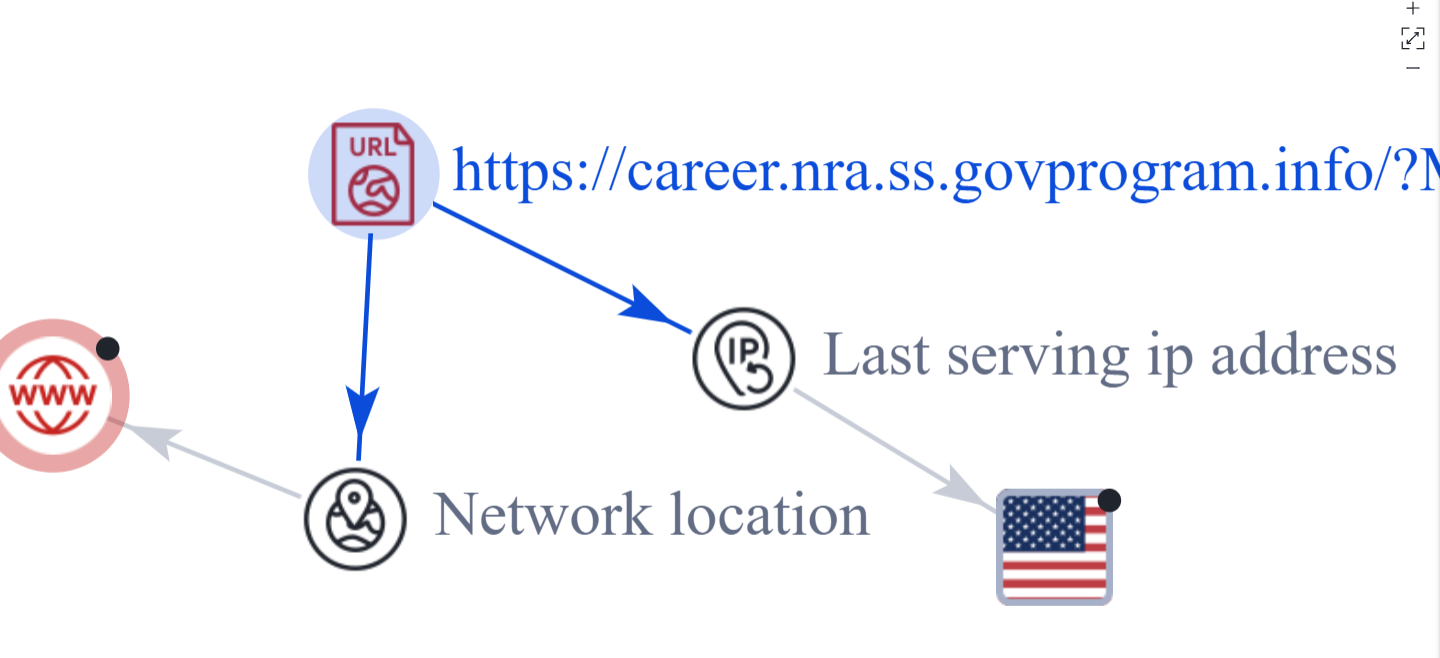
Graphically the link is being hosted in the United States of America.

Scammers don’t relax. This year alone, two different scams about jobs from the National Revenue Authority (NRA) on social media have been investigated by 211 Check, as seen here and here. 

Conclusion:

211 Check finds that the advert claiming to be from National Revenue Authority South Sudan is false. These are scams embedded with Malicious and Phishing links intended to steal people’s helpful information. We advise the public to be cautious when interacting with such social media posts and verify the authenticity of any claims before acting on them.

To ensure accuracy and transparency, we at 211 Check welcome corrections from our readers. If you spot an error in this article, please request a correction using this form. Our team will review your request and make the necessary corrections immediately, if any.

It is crucial to fight against misinformation and disinformation in mainstream and alternative media by avoiding becoming a victim of fake news. To prevent the spread of false information, you must refrain from sharing content you are unsure about or unaware of its origin. Disinformation and misinformation can be incredibly dangerous because they can mislead people and cause harm. For instance, false information on health matters can lead to wrong decisions that can put people’s lives at risk. Therefore, it’s vital to fact-check information before sharing it to promote accurate and reliable information. Visit https://211check.org/ for more information on our fact-checking process, or send us a WhatsApp message at +211 917 298 255 if you want to present a claim. Our team will promptly respond to your request because we believe #FactsMatter.

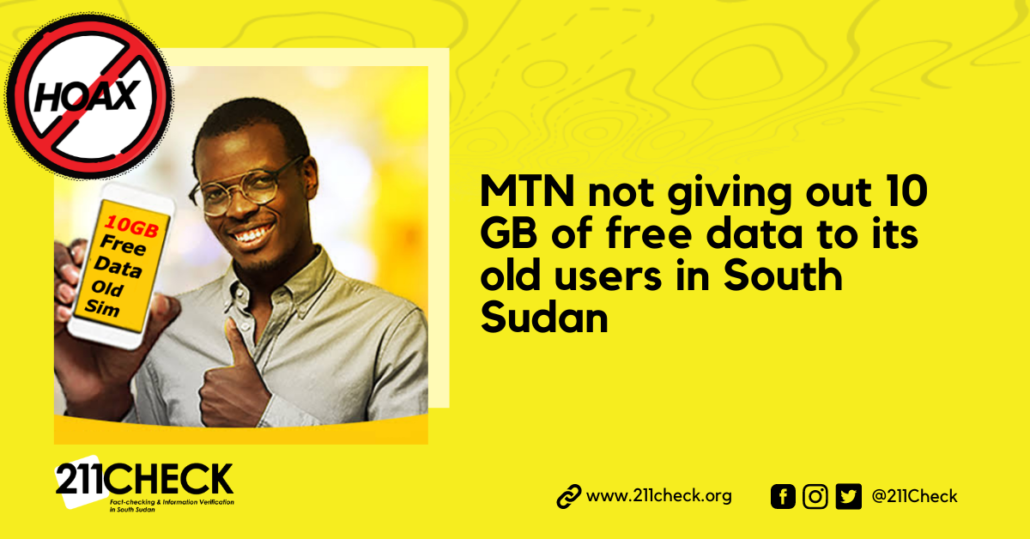
Fact-check: MTN not giving out 10 GB of free data to its old users in South Sudan

The circulating WhatsApp message claiming that MTN is giving out 10 GB of free data to its old users in South Sudan is fake and being used by scammers.

Writer: Jibi Moses 

An advert making rounds on social media with MTN pictures claiming to give 10 GB of internet bundles to its old users who have at least one year above is false.

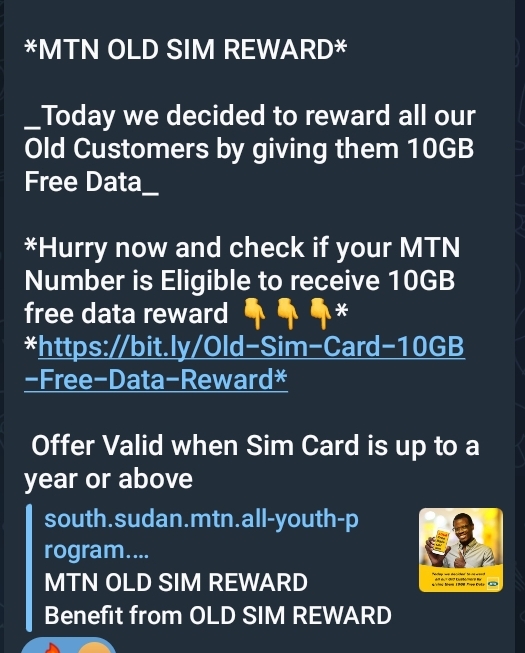
“MTN OLD SIM REWARD. Today we decided to reward all our old customers by giving them 10GB of Free Data,” the WhatsApp message reads in part.

The screenshot of the advert was shared in one of the social media groups.

Screenshot of the malicious webpage

The link has been shared widely with forty-two thousand shares, fifty-three thousand comments, and over 210 thousand reactions. This makes it suspicious. 

What truth does this hold? Is MTN giving 10 GB of free data?

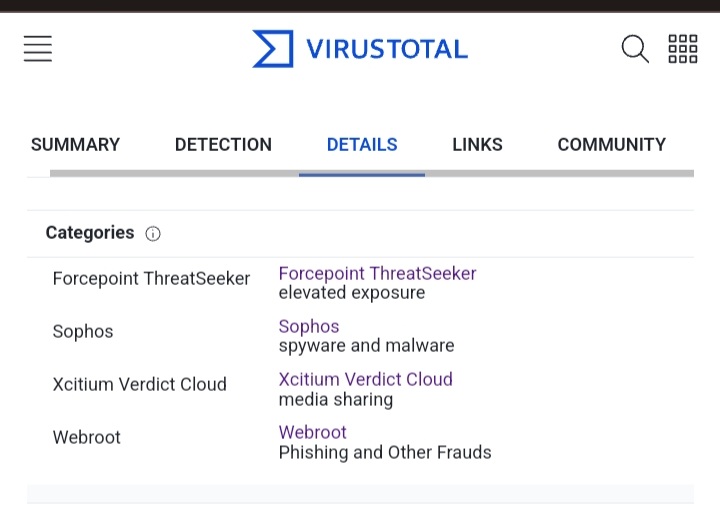
211 Check ran a link scan using Virustotal, an online tool that helps internet users detect malicious links. Three security vendors flagged the URL as malicious. Meanwhile, one flagged it as suspicious. 

Screenshots of the virus total scan results.

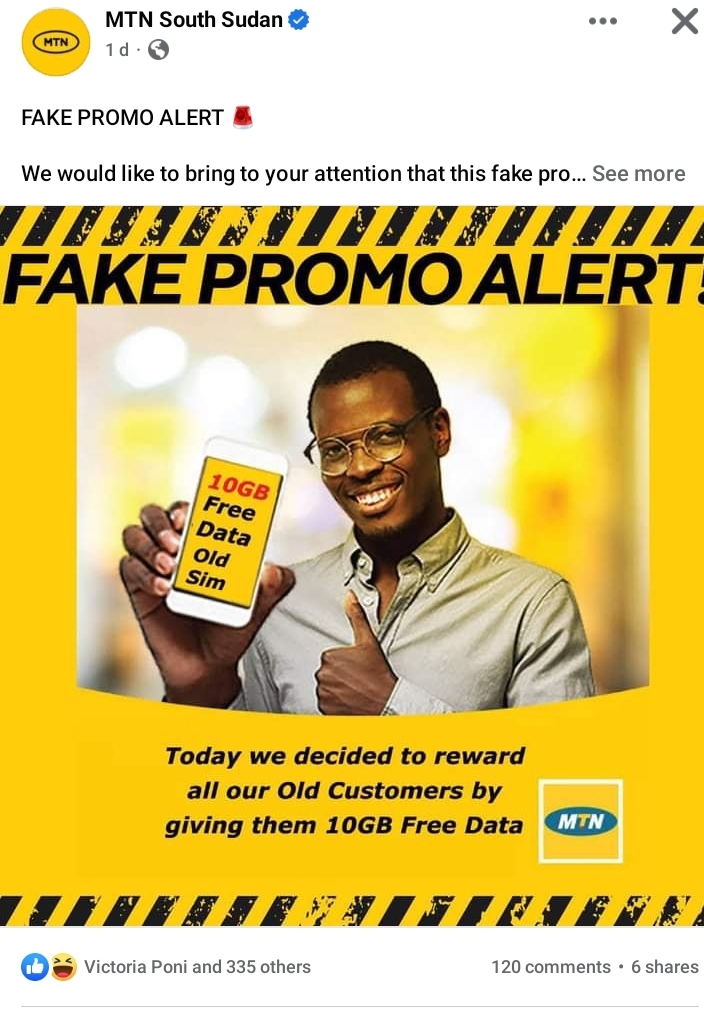
MTN South Sudan, through its Facebook, also published a disclaimer with the heading FAKE PROMOTION ALERT and warned the public to stay woke. Previously a similar advert made rounds on social media from MTN Uganda, and 211 Check fact-checked it here.

Screenshot of the MTN South Sudan alert.

Conclusion:

211 Check finds the claim as an advert purporting that MTN South Sudan is offering 10 GB of free data to old customers who have used their sim cards for more than a year false. These scams are embedded with malicious and suspicious links to steal people’s helpful information. We advise the public to be cautious when interacting with such social media posts and verify the authenticity of any claims before acting on them.

To ensure accuracy and transparency, we at 211 Check welcome corrections from our readers. If you spot an error in this article, please request a correction using this form. Our team will review your request and make the necessary corrections immediately, if any.

It is crucial to fight against misinformation and disinformation in mainstream and alternative media by avoiding becoming a victim of fake news. To prevent the spread of false information, you must refrain from sharing content you are unsure about or unaware of its origin. Disinformation and misinformation can be incredibly dangerous because they can mislead people and cause harm. For instance, false information on health matters can lead to wrong decisions that can put people’s lives at risk. Therefore, it’s vital to fact-check information before sharing it to promote accurate and reliable information. Visit https://211check.org/ for more information on our fact-checking process, or send us a WhatsApp message at +211 917 298 255 if you want to present a claim. Our team will promptly respond to your request because we believe #FactsMatter.

Explainer: Aflatoxins – What You Need to Know

Aflatoxin is a dangerous toxin produced by fungi that grow on crops and can cause cancer, liver damage, and growth problems in humans and animals. It is a significant food safety issue in many parts of the world, especially in developing countries.

Writer: Beatrice Amude Paulino

A media report by South Sudan’s Juba-based Eye Radio says the South Sudan Bureau of Standards has impounded forty containers of maize flour from Uganda at the Nimule border on claims that they are affected by Aflatoxin fungi according to preliminary laboratory tests.

At least 40 containers of substandard maize flour were confiscated at the Nimule border,” said the South Sudan Bureau of Standards Chief Executive Officer, Mary Gordon.

‘’We found some substances in the food items, especially the maize flour from Uganda. It has not expired, but the chemical ( aflatoxin) acquired harms human consumption. Forty containers have been stopped from proceeding to Juba,’’ said the clearance Agents Association Chairperson, Daniel Deng

Courtesy image

211 Check takes a look at how this type of fungi affects food, and here is what we found out:

What is Aflatoxin?

Aflatoxins are a family of toxins produced by certain fungi found on crops such as maize (corn), peanuts, cottonseed, and tree nuts. The primary fungi that produce aflatoxins are Aspergillus flavus and Aspergillus parasiticus, which are abundant in warm and humid regions of the world. Aflatoxin-producing fungi can contaminate crops in the field, at harvest, and during storage.

People can be exposed to aflatoxins by eating contaminated plant products (such as peanuts) or meat or dairy products from animals that ate contaminated feed. Farmers and other agricultural workers may be exposed by inhaling dust generated while handling and processing contaminated crops and feeds.

Image showing corn infected by aflatoxin

What are the common causes of aflatoxin?

Aflatoxin is caused by certain strains of fungi, such as Aspergillus flavus and Aspergillus parasiticus. These fungi are commonly found in soil and can grow on crops such as peanuts, cottonseed, corn, and tree nuts, especially when stored in warm and humid conditions. The fungi produce aflatoxin as part of their natural metabolic processes, which can contaminate food and feed products. Factors that can increase the risk of aflatoxin contamination include poor storage conditions, improper handling and processing of crops, and insect damage to crops. Climate conditions such as drought or excessive rainfall can also contribute to higher levels of crop aflatoxin production.

What are the dangers of exposing people to aflatoxin?

Aflatoxin is a Potent Carcinogen that can cause liver damage, immune system suppression, and growth impairment in humans and animals. The health effects of aflatoxin exposure depend on the level and duration of exposure, as well as individual susceptibility. In acute high-level exposure cases, symptoms may include liver damage, vomiting, abdominal pain, and convulsions. Chronic exposure to low levels of aflatoxin over a prolonged period may increase the risk of developing liver cancer, particularly in populations with existing liver diseases, such as hepatitis B or C infections. Aflatoxin exposure has also been linked to other types of cancer, including lung and colorectal cancer. Children and infants are particularly vulnerable to the harmful effects of aflatoxin, which can result in stunted growth, malnutrition, and impaired immune function.

Ways of preventing aflatoxin from contaminating food

Aflatoxin is a type of toxin produced by certain moulds, especially Aspergillus flavus and Aspergillus parasiticus. It can contaminate many crops, including grains, nuts, and seeds, and is a significant food safety concern worldwide.

There are several ways to prevent aflatoxin contamination in food:

  1. Proper storage: Aflatoxin-producing moulds thrive in warm, humid conditions. Therefore, storing food in excellent, dry places can help prevent the growth of these moulds.
  2. Good agricultural practices: Farmers can reduce the risk of aflatoxin contamination by using good agricultural practices such as crop rotation, proper irrigation, and timely harvesting and storage of crops.
  3. Biological control: Several strains of non-toxic Aspergillus fungi can be used to compete with and displace the toxic strains that produce aflatoxin.
  4. Chemical control: Fungicides can be applied to crops to control the growth of aflatoxin-producing moulds.
  5. Screening and testing: Regular screening and testing of food products for the presence of aflatoxin can help identify contaminated batches before they enter the food supply chain.

It’s important to note that prevention is vital regarding aflatoxin, as there is no practical way to remove it once it has contaminated food. Therefore, taking proactive steps to prevent contamination is critical for protecting human health.

How can farmers reduce the risk of aflatoxin?

Farmers can take several steps to reduce the risk of aflatoxin contamination in their crops:

  1. Crop management: Proper crop management practices can help reduce the risk of aflatoxin contamination. This includes planting resistant varieties, using proper irrigation techniques, and ensuring that crops are harvested at the correct time.
  2. Pest control: Pests such as insects and rodents can damage crops and create favourable conditions for the growth of aflatoxin-producing moulds. Farmers can minimise pest damage through integrated pest management practices, which may include cultural, biological, and chemical controls.
  3. Drying and storage: Aflatoxin-producing moulds thrive in warm, humid environments. Therefore, farmers should ensure that crops are dried and stored in excellent conditions. This can be achieved using drying and storage facilities that maintain appropriate temperature and humidity levels.
  4. Regular monitoring: Farmers should regularly monitor their crops for signs of mould growth and other indicators of aflatoxin contamination. This can involve visual inspections and laboratory testing samples from different farm areas.
  5. Training and education: Farmers can benefit from training and educational programs that teach them about the risks of aflatoxin contamination and the best prevention practices. This can include information on crop management, pest control, and proper drying and storage techniques.

Farmers can help reduce the risk of aflatoxin contamination in their crops by taking these steps, leading to safer and healthier food for consumers.

Treatment for aflatoxin infection

The treatment for aflatoxin exposure depends on the severity of the illness and the specific symptoms exhibited. Hospitalisation may be necessary in cases of acute poisoning to manage symptoms such as vomiting, dehydration, and convulsions. Supportive care may also be required, including intravenous fluids, electrolyte replacement, and nutritional support.

However, there is no specific antidote for aflatoxin poisoning, and treatment mainly focuses on managing symptoms and preventing further exposure. In cases of chronic exposure, long-term monitoring and management of liver function may be necessary to reduce the risk of developing liver cancer. Prevention is the most effective way to reduce the risk of aflatoxin exposure, which includes measures such as proper storage and handling of food and feed products, regular testing for contamination, and strict regulatory controls.

Conclusion

It is essential to prevent or reduce aflatoxin contamination by implementing good agricultural practices, proper storage conditions, and regular monitoring of crops for aflatoxin levels. The Government has already started screening or examining food and non-food items imported into the country at the border.

To ensure accuracy and transparency, we at 211 Check welcome corrections from our readers. If you spot an error in this article, please request a correction using this form. Our team will review your request and make the necessary corrections immediately, if any.

Fact-check: “Are you from South Sudan?” Job Scams

These sites are malicious, masquerading as genuine ones, but they steal people’s information. 

Writer: Jibi Moses

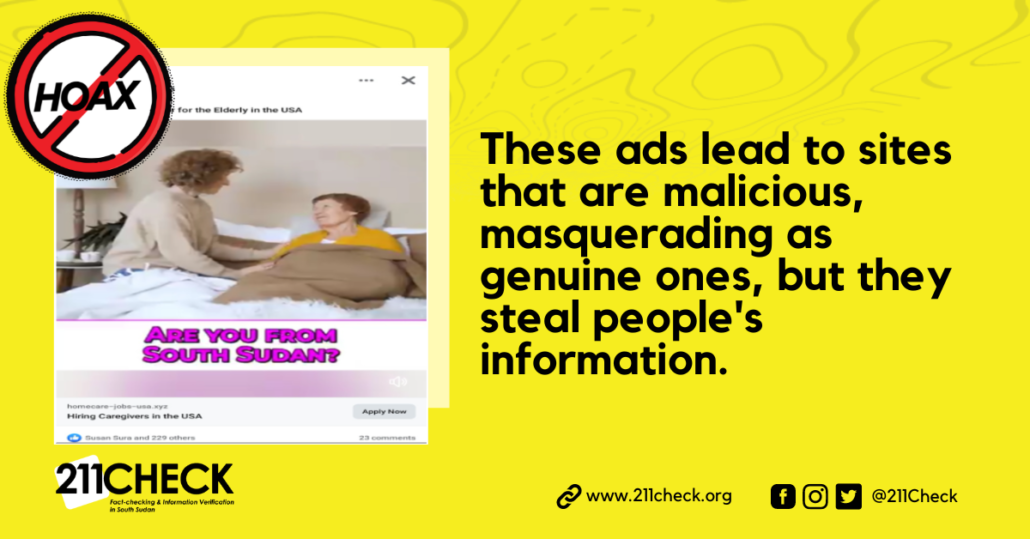
If you are a regular Facebook and Messenger user, you must have encountered multiple sponsored Facebook job advertisements on various pages. The pages which run a series of these ads claim there are jobs in the US or Canada for people from South Sudan.

These pages, among others, are; Exact Grant (here, here and here), Jobs Global Center (here) and Study for You (Here).  

The adverts run with different headings, such as “Hiring Caregivers in the USA | jobs as a night carer for the elderly” and “Looking for jobs that are right for you.”

These posts claim that the jobs include housekeeping, elderly caregiving, driving, supermarket attendants, construction and painting. The pages make further claims about how people will be paid per hour, ranging from 25 USD to 50 USD, depending on what one intends to apply for, and every opportunity doesn’t require experience. 

Screenshots of one of the adverts from Exact Grant.

Investigation:

These adverts are everywhere on Facebook and are concentrated on South Sudanese. And many people were commenting, showing interest in applying for these jobs, which raised concern, and 211Check ran an investigation. However, on opening the site, they immediately lead one to  Home-care-jobs-usa-xyz.

This also has several other sponsored adverts, including, among others, Americanmobile.com, TravelNursing.com, and Travel Nursing Jobs. These are legitimate Nurse staffing agencies with enough experience in doing their work according to the detailed information on their websites and the whois details, all located and registered in the United States of America. Here are their whois details respectively. (Here, here, here). These three companies were registered long ago, the earliest in 1997 and the latest in 2001.

However, on scanning the link Home-care-jobs-usa-xyz using Virustotal, 211 Check found that it has a suspicious, as detected by Forcepoint Threatseeker.

As it operates, Forcepoint ThreatSeeker Intelligence: Monitors popular websites to see if they’ve been compromised or hijacked. Follows breaking news, trending topics and viral social media to identify additional content to assess.

A browser hijacker is a malware program that modifies web browser settings without the user’s permission and redirects the user to websites the user had not intended to visit. It is often called a browser redirect virus because it redirects the browser to other, usually malicious, websites.

Cybercriminals create malicious websites to steal data and plant malware such as ransomware. These websites often masquerade as legitimate ones and use phishing emails to lure visitors

Screenshot of the virus total results.

Conclusion 

The adverts running through different platforms claiming to offer jobs to South Sudanese are mainly false; these ads contain malware intentionally created to divert users to websites they don’t intend to use. These sites are malicious, masquerading as genuine ones, but they steal people’s information. 

To ensure accuracy and transparency, we at 211 Check welcome corrections from our readers. If you spot an error in this article, please request a correction using this form. Our team will review your request and make the necessary corrections immediately, if any.
It is crucial to fight against misinformation and disinformation in mainstream and alternative media by avoiding becoming a victim of fake news. To prevent the spread of false information, you must refrain from sharing content you are unsure about or unaware of its origin. Disinformation and misinformation can be incredibly dangerous because they can mislead people and cause harm. For instance, false information on health matters can lead to wrong decisions that can put people’s lives at risk. Therefore, it’s vital to fact-check information before sharing it to promote accurate and reliable information. Visit https://211check.org/ for more information on our fact-checking process, or send us a WhatsApp message at +211 917 298 255 if you want to present a claim. Our team will promptly respond to your request because we believe #FactsMatter.

Blog: The psychology behind why people create online scams and fraud

We explore the psychology behind online scams and frauds, including common tactics used by scammers, the impact of such activities on individuals and society, legal consequences for those participating in these activities, and ways to verify the authenticity and protect oneself from online fraud.

Writer: Emmanuel Bida Thomas

Unfortunately, online scams and frauds are all too common in today’s digital age. Despite efforts to increase awareness and educate people about these types of fraud, they continue to occur at an alarming rate. The psychology behind why people create online scams and frauds is complex and multifaceted. In this blog post, we’ll explore some of the common tactics used by scammers, the impact of online scams and frauds on individuals and society as a whole, the legal consequences of participating in online scams and frauds, how to verify the authenticity of scams such as job offers or recruitment messages, and how to protect oneself from online job scams and frauds.

The global prevalence of online scams and fraud

According to PwC’s Global Economic Crime and Fraud Survey 2022, 51% of surveyed organisations say they experienced fraud in the past two years, the highest level in their 20 years of research. The survey of 1,296 executives across 53 countries and regions also shows that fraudsters are becoming more sophisticated in their tactics. In a survey of over 5,000 respondents across 99 global territories in 2020, PricewaterhouseCoopers (PwC) found that 47 per cent had suffered at least one form of fraud in the prior 24 months—averaging six per company. These were commonly customer fraud, cybercrime, asset misappropriation, bribery, and corruption, costing $42 billion.

The Psychology Behind Online Scams and Frauds

The desire for financial gain is the root of most online scams and frauds. Scammers often use social engineering techniques to manipulate victims into giving up personal information, money, or sensitive data. These techniques exploit human vulnerabilities, including fear, curiosity, greed, and compassion. For example, some scammers may pose as a trustworthy authority figures, such as a doctor or government official, to convince their victims to hand over sensitive information.

Others may use emotional appeals, promising quick riches or presenting themselves as long-lost friends or loved ones needing urgent help. Still, others may use threats or blackmail to extort money or information from their victims. Ultimately, the success of any scam relies on the victim’s willingness to trust the scammer and act upon their demands.

Socio-economic factors contributing to online scams and positive impacts

Some people may use online scams to survive in countries with limited economic opportunities. While this does not justify fraudulent behaviour, it is essential to acknowledge that underlying socioeconomic factors may contribute to the prevalence of online scams.

It’s important to understand that people engage in fraudulent behaviour for various reasons. These reasons are often related to broader societal issues such as poverty, inequality, and lack of access to education and economic opportunities. While it’s never acceptable to engage in fraud or other illegal activities, addressing the root causes of these behaviours is essential to create a more just and equitable society. One way to do this is by investing in programs and policies that promote economic growth and opportunity, improve access to education and training, and support marginalised communities. A holistic approach to addressing these issues can reduce the prevalence of online scams and other forms of fraud while promoting more significant social and economic justice.

It is difficult to find any positive impacts of online scams. However, some studies suggest that online shaming can have positive influences, such as the communication of group norms and the punishment of their violation by elevating the status of those enforcing them. 

The four stages of a scam are:

The typical stages of a scam are from when the scammer first contacts a potential victim to the victim realising they’ve been defrauded.

The opportunity is also called setup: Scammers contact potential victims. They often have tremendous success if the victim is experiencing a vulnerable period in their life. The scammer sets up the scam, which involves creating a fake story or scenario to trick the victim into parting with their money or personal information. 

The hook or scam itself: The scammer makes initial contact with the victim and uses various tactics to gain their trust and confidence, such as offering a fake investment opportunity or pretending to be a government agency. Fraudsters create a credible fake story to target victims, such as a bank staff member, an investment expert, a seller of goods or a romantic interest. Scammers use imitation to appear more believable. Tactics include spoofing phone numbers or using fake reviews to create credible online ads. Scammers build a relationship with the victim by appearing likeable and establishing similarities.

The payoff, known as payment: The scammer convinces the victim to send them money or provide personal information, often by promising a significant return on investment or threatening legal action if they don’t comply. Scammers create an overwhelming sense of urgency, leaving victims little time to double-check details and manipulating them into dismissing warnings from experts, family members or friends.

The endgame and aftermath: The scammer disappears with the victim’s money or personal information, leaving them with little recourse for recovery. In some cases, the scammer may continue to contact the victim to get more money or information from them. The victim realises that they’ve been scammed, often causing feelings of distress and shame. Too often, banks and the police don’t deal with the situation well, leaving the victim under further stress. On many occasions, the victim isn’t reimbursed for their losses.

Common Tactics Used by Scammers

Scammers use various tactics to trick people into giving them money or personal information. Some of the most common tactics used by scammers include impersonation, urgency, and emotional manipulation:

  • Phishing emails and text messages: Appear to be from a reputable source but contain links or attachments that install malware or steal personal information.
  • Advance fee scams: These are scams where the scammer poses as a wealthy individual who needs help transferring funds out of their country. The victim is promised a reward for helping but is asked to pay various fees upfront, which are never returned.
  • Charity scams: These are scams where the scammer poses as a charitable organisation and solicits donations from unsuspecting individuals. The money collected is often never used for its intended purpose.
  • Impersonation scams: These are scams where the scammer poses as a legitimate authority figure, such as a government official, police officer, or bank representative. They use this guise to obtain personal or sensitive information from their victims.

Impact of Online Scams and Frauds

The impact of online scams and frauds can devastate individuals and society. Victims can suffer financial losses, identity theft, and emotional distress. Online scams and frauds can undermine trust in institutions and the economy. Victims may also face legal consequences if they unknowingly participate in illegal activities, such as money laundering or wire fraud.

Online scams and frauds impact society, eroding trust and confidence in digital transactions and communication. This can lead to decreased adoption of new technologies and increased costs for businesses that must invest in cybersecurity measures to protect themselves and their customers. According to the International Monetary Fund (IMF), incidents that corrupt the integrity of financial data can potentially undermine trust and confidence more broadly. In addition, exposure to online misinformation has been linked to lower trust in mainstream media across party lines.

Legal Consequences of Participating in Online Scams and Frauds

Participating in online scams and frauds can have serious legal consequences. Depending on the nature and scope of the scam, individuals who are caught may face fines, imprisonment, or both. In some cases, individuals may also be required to pay restitution to their victims.

How to Verify the Authenticity of Scams

It’s important to verify the authenticity of any message or job offer before providing personal or sensitive information. Some ways to do this include:

-Researching the company or organisation online to see if they have a legitimate website or social media presence.

  • Contact the company or organisation directly to confirm the message’s legitimacy or offer.
  • Checking with relevant authorities, such as the Better Business Bureau or local law enforcement, to see if any reports of fraud or scams are associated with the company or organisation.

How to Protect Oneself from Online Scams and Frauds

There are several things that individuals can do to protect themselves from online scams and frauds:

  • Be cautious about providing personal or sensitive information online.
  • Avoid clicking on links or downloading attachments from unknown sources.
  • Use strong passwords and two-factor authentication for online accounts.
  • Install antivirus software and keep it updated.
  • Report any suspicious activity to relevant authorities.

A fairer system for scam victims

South Sudan has been plagued by scams and frauds, leaving many victims without justice or compensation. To establish a fairer system, the establishment of Computer Incident Response Term (CIRT), a centralised government agency by the National Community Authority, should be expedited to handle scams and fraud reports. CIRT should employ trained investigators who work with victims to gather evidence and pursue legal action against scammers. Scam victims should be provided with counselling services, information on avoiding scams and establishing a compensation fund in the future. The legal system must be strengthened to ensure that scammers are held accountable, and victims receive justice. Education and awareness campaigns could be implemented to help prevent future scams by educating the public on how to spot and avoid them.

Computer Incident Response Teams (CIRTs) can effectively combat online scams by providing a coordinated and rapid response to security incidents. CIRTs can help to identify and contain security incidents, minimise damage, and restore normal operations as quickly as possible. They can also help to prevent future incidents by identifying vulnerabilities and implementing security measures to address them. 

While implementing such a system may require significant resources and effort, it could provide much-needed support and justice to victims of scams in South Sudan.

New laws could provide more excellent protection

Two significant pieces of legislation that are yet to go through parliament will help to provide improved protections against scams or help for scam victims in South Sudan:

The Data Protection Bill aims to regulate the collection, use, storage, and sharing of personal data by individuals, organisations, and institutions. It will hold online platforms responsible for fraudulent content and ads, which means that they will be required to take steps to prevent the spread of malicious advertisements and fake news on their platforms. This could help reduce the number of online scams and provide more excellent protection to consumers who may fall victim to these scams.

The Cybercrime and Computer Misuse Bill addresses cybercrime activities such as hacking, identity theft, and phishing. The bill criminalises computer-related offences and provides penalties for those found guilty of engaging in such activities. This bill can help deter cybercriminals from carrying out illegal activities by imposing stiff penalties and providing a legal framework within which law enforcement agencies can investigate and prosecute cybercriminals.

Conclusion

Unfortunately, online scams and frauds are a reality in today’s digital age. The psychology behind why people create these types of fraud is complex but often involves a desire for financial gain. To protect oneself from these types of scams, it’s essential to be cautious about providing personal information online and to verify the authenticity of any message or job offer before acting upon it. By staying vigilant and informed, individuals can avoid falling victim to online scams and fraud.

To ensure accuracy and transparency, we at 211 Check welcome corrections from our readers. If you spot an error in this article, please request a correction using this form. Our team will review your request and make the necessary corrections immediately, if any.

Explainer: Propaganda, misinformation or disinformation; what are they?

Analysts generally agree that disinformation is always purposeful and not necessarily composed of lies or fabrications. It can be composed of primarily true facts, stripped of context or blended with falsehoods to support the intended message, and is always part of a larger plan or agenda.

Writer: Jibi Moses

Propaganda is disseminating information—facts, arguments, rumours, half-truths, or lies—to influence public opinion.

Propaganda is the more or less systematic effort to manipulate other people’s beliefs, attitudes, or actions using symbols (words, gestures, banners, monuments, music, clothing, insignia, hairstyles, designs on coins and postage stamps, and so forth). Deliberateness and a heavy emphasis on manipulation distinguish propaganda from casual conversation or the free and easy exchange of ideas. Propagandists have a specific goal or set of goals. To achieve these, they deliberately select facts, arguments, and displays of symbols and present them in ways they think will have the most effect. To maximise effect, they may omit or distort pertinent facts or lie, and they may try to divert the attention of the reactors (the people they are trying to sway) from everything but their own propaganda.

Comparatively deliberate selectivity and manipulation also distinguish propaganda from Education. Educators try to present various sides of an issue—the grounds for doubting, the grounds for believing their statements, and the disadvantages and advantages of every conceivable course of action. Education aims to induce reactors to collect and evaluate evidence for themselves and assists them in learning the techniques for doing so. It must be noted, however, that some propagandists may look upon themselves as educators and may believe that they are uttering the purest truth, that they are emphasising or distorting certain aspects of the truth only to make a valid message more persuasive, or that the courses of action that they recommend are the best actions that the reactor could take. By the same token, the reactor who regards the propagandist’s message as self-evident truth may think of it as educational; this often seems to be the case with “true believers”—dogmatic reactors to dogmatic religious, social, or political propaganda. “Education” for one person may be “propaganda” for another.

Propaganda and related concepts

Connotations of the term propaganda

The word propaganda itself, as used in recent centuries, apparently derives from the title and work of the Congregatio de Propaganda Fide (Congregation for Propagation of the Faith), an organisation of Roman Catholic cardinals founded in 1622 to carry on missionary work. To many Roman Catholics, the word may have a highly respectable connotation, at least in missionary or ecclesiastical terms. But even to these persons, and indeed, to many others, the term is often a pejorative one tending to connote such things as the discredited atrocity stories and deceptively stated war aims of World Wars I and II, the operations of the Nazis’ Ministry of Public Enlightenment and Propaganda, and the broken campaign promises of a thousand politicians. Also, it is reminiscent of countless instances of false and misleading advertising (especially in countries using Latin languages, in which propaganda commercials or some equivalent is a common term for commercial advertising).

Alfred M. Lee and Elizabeth B. Lee classified the Propaganda devices into seven major categories: name-calling, Glittering generalities, transfer, testimonial, Plain-folk, Card-stacking and Bandwagon.

Misinformation is false or inaccurate information. Examples include rumours, insults and pranks. Disinformation is deliberate and includes malicious content such as hoaxes, spear phishing and propaganda. It spreads fear and suspicion among the population. The following are the categories of misinformation and disinformation: Fabricated Content: Completely false content; Manipulated Content: Genuine information or imagery that has been distorted like a sensational headline or populist ‘clickbait’; Imposter Content: Impersonation of genuine sources, e.g. using the branding of an established agency; Misleading Content: Misleading information, like a comment presented as fact; False Context: Factually accurate content combined with false contextual information, e.g. when the headline of an article does not reflect the content; Satire and Parody: Humorous but false stores passed off as true. There is no intention to harm, but readers may be fooled; False Connections: When headlines, visuals or captions do not support the content; Sponsored Content: Advertising or PR disguised as editorial content; Propaganda: Content used to manage attitudes, values and knowledge; and Error: A mistake made by established new agencies in their reporting. 

The rise of Artificial Intelligence (AI) has also given birth to new forms of misinformation and disinformation. We call this Synthetic Media to indicate the artificial production, manipulation and modification of data and multimedia by automated means, especially AI algorithms, to mislead or change the original meaning. There are fears that synthetic media could supercharge fake news, spread misinformation and distrust of reality and automate creative jobs. ‘Deep Fakes’ are one type of synthetic media where a person in an existing image or video is replaced with someone else’s likeness. While faking content is not new, deep fakes use powerful techniques from machine learning and AI to manipulate or generate visual and audio content with a high potential to deceive. Deep Fakes have garnered widespread attention for their use in revenge porn, fake news, hoaxes and financial fraud. Industry and governments are concerned to detect and limit their use. Some countries already have a national response, or institutions are working on it. “Speech Synthesis” is another branch of synthetic media that can artificially produce human speech. A computer used for this purpose is called a “speech computer” or “speech synthesiser”. Synthesised speech concatenates pieces of recorded speech or incorporates a model of the vocal tract and other human voice characteristics to create a completely “synthetic” voice.

In addition to new and more sophisticated ways of manipulating content, there are also a growing number of ways in which Social Media can be used to manipulate conversations: A Sockpuppet is an online identity used to deceive. The term now extends to misleading uses of online identities to praise, defend or support a person or organisation; to manipulate public opinion; or to circumvent restrictions, suspension or an outright ban from a website. The difference between a pseudonym and a sockpuppet is that the sockpuppet poses as an independent third party, unaffiliated with the main account holder. Sock Puppets are unwelcome in many online communities and forums; Sealioning is a type of trolling or harassment where people are pursued with persistent requests for evidence or repeated questions. A pretence of civility and sincerity is maintained with these incessant, bad-faith invitations to debate; Astroturfing masks the sponsors of a message (e.g. political, religious, advertising or PR organisations) to make it appear as though it comes from grassroots participants. The practice aims to give organisations credibility by withholding information about their motives or financial connections; Catfishing is a form of fraud where a person creates a sockpuppet or fake identity to target a particular victim on Social Media. It is common for romance scams on dating websites. It may be done for financial gain, to compromise a victim or as a form of trolling or wish fulfilment.

Disinformation is a relatively new word. Most observers trace it back to the Russian word dezinformatsiya, which Soviet planners in the 1950s defined as “dissemination (in the press, on the radio, etc.) of false reports intended to mislead public opinion.” Others suggest that the earliest use of the term originated in 1930s Nazi Germany. In either case, it is much younger (and less commonly used) than ‘propaganda,’ which originated in the 1600s and generally connoted the selective use of information for political effect.

Whether and to what degree these terms overlap is subject to debate. Some define propaganda as using non-rational arguments to either advance or undermine a political ideal and use disinformation as an alternative name for undermining propaganda. Others consider them to be separate concepts altogether. One popular distinction holds that disinformation also describes politically motivated messaging designed explicitly to engender public cynicism, uncertainty, apathy, distrust, and paranoia, which disincentivise citizen engagement and mobilisation for social or political change. “Misinformation” generally refers to the inadvertent sharing of false information.

Analysts generally agree that disinformation is always purposeful and not necessarily composed of lies or fabrications. It can be composed of primarily true facts, stripped of context or blended with falsehoods to support the intended message, and is always part of a larger plan or agenda. In the Russian context, observers have described its use to pursue Moscow’s foreign policy goals through a “4D” offensive: dismiss an opponent’s claims or allegations, distort events to serve political purposes, distract from one’s own activities, and dismay those who might otherwise oppose one’s goals.

To ensure accuracy and transparency, we at 211 Check welcome corrections from our readers. If you spot an error in this article, please request a correction using this form. Our team will review your request and make the necessary corrections immediately, if any.
Explainer: Distributed Denial of Service Attack (DDoS Attack)

This article discusses Distributed Denial of Service (DDoS) attacks, how they can be prevented and mitigated, and their potential impact on businesses.

Writer: Jibi Moses

Distributed denial of service (DDoS) attacks are now everyday occurrences. Whether a small non-profit or a huge multinational conglomerate, the organisation’s online services—email, websites, anything that faces the internet—can be slowed or completely stopped by a DDoS attack. For data centres, colocation, hosting and other service providers, DDoS attacks threaten the infrastructure that provides network and service availability to all its tenants, subscribers and customers and can target the most valuable customers.

A successful DDoS attack can seriously damage a brand’s reputation and cost hundreds or even millions of dollars in revenue. Moreover, DDoS attacks are sometimes used to distract cybersecurity operations while other criminal activity, such as data theft or network infiltration, is underway.

A Denial-of-Service (DoS) attack shuts down a machine or network, making it inaccessible to its intended users. DoS attacks accomplish this by flooding the target with traffic or sending it information that triggers a crash. Some definitions of the DoS can be found here, here, here and here.

Network traffic is the data moving across a computer network at any given time. Network traffic, also called data traffic, is broken down into data packets and sent over a network before being reassembled by the receiving device or computer.  In the case of an attack, keep sight of the other hosts, assets, or services residing on your network.

Meanwhile, a Distributed denial-of-Service (DDoS) attack is a DoS attack that uses multiple computers or machines to flood a targeted resource. Both attacks overload a server or web application, intending to interrupt services. 

Many attackers conduct DoS or DDoS attacks to deflect attention away from their intended target and use the opportunity to conduct secondary attacks on other services within your network. 

These attacks come in many forms: Volume-based attacks, Protocol attacks, Application-layer attacks, UDP attacks, ICMP attacks, Ping of death, Slowloris, and NTP application attacks. 

All the above affect the victim(s) differently but with a similar intention of disrupting the user. However, this doesn’t give the attacker access to the website he/ she has attacked.

A recent example of a DDoS attack in South Sudan was the attack on the Bank of South Sudan site. The local media was awash with the news, as reported by Eye Radio, CityReview, and Sudan Post, A mysterious group calling itself Anonymous South Sudan, claimed responsibility of the attack, citing high inflation rates as the main reason for hacking the bank’s website. Calling for a drop in the wanted South Sudanese Pounds exchange rate to  400 SSPP per 1 USD.

Besides in the other parts of the world, there are some popular and recent DDoS attacks; the Github hub attack in Feb 2018, the Mirai botnet attack in 2016, The AWS DDoS Attack in 2020 and the European Gambling Company in 2021.

Meanwhile, Denial of Service should be distinct from Hacking. According to Malwarebytes: Hacking refers to activities that seek to compromise digital devices, such as computers, smartphones, tablets, and even entire networks. And while hacking might not always be for malicious purposes, nowadays, most references to hacking, and hackers, characterise it/them as unlawful activity by cybercriminals—motivated by financial gain, protest, information gathering (spying), and even just for the “fun” of the challenge. Another point is that hackers have total control of the site or whatever they have broken into, unlike DDoS, whereby the system is flooded with traffic to interrupt the system. However, DDoS is one of the many tools for hacking. 

Prevention:

DDoS (Distributed Denial of Service) attacks can be challenging to prevent completely, but there are several measures that you can take to minimise their impact. Here are some steps to stop a DDoS attack on your website:

  1. Use a DDoS protection service: Consider using a third-party DDoS protection service to detect and mitigate attacks in real-time.
  1. Increase your server capacity: DDoS attacks can cause your website to become unavailable due to overwhelming traffic. Increasing your server capacity can help your website handle the traffic and remain available during an attack.
  1. Use a CDN (Content Delivery Network): A CDN can help distribute the traffic to multiple servers and reduce the load on your website, making it more resilient to DDoS attacks.
  1. Configure your firewall: Configure your firewall to block traffic from known malicious IP addresses, limit connections from a single IP address, and filter traffic based on specific patterns common in DDoS attacks.
  1. Keep your software up to date: Regularly update your website software, including the operating system, web server, and any third-party applications, to ensure that they are free from known vulnerabilities that could be exploited in a DDoS attack.
  1. Monitor your traffic: Analyze your traffic logs to identify any unusual traffic patterns that could indicate a DDoS attack. Using a monitoring tool can help you detect attacks early and take steps to mitigate them.
  1. Have a DDoS response plan: Develop a DDoS response plan that outlines the steps you will take in the event of an attack. This should include procedures for notifying your hosting provider, engaging a DDoS protection service, and communicating with your users.

What next if attacked?

Resolving a DDoS attack can be challenging, but there are several steps you can take to mitigate its effects: Identify the source of the attack: Determine where the attack is coming from and which systems or machines are being used to launch it. Block traffic from the attacking IPs: Once you know where the attack is coming from, block all traffic from those IP addresses to your network or website. Filter traffic: Apply filters to incoming traffic to identify and block malicious traffic and allow legitimate traffic. Increase server capacity: Add more servers or bandwidth to handle the increased traffic load. Use a Content Delivery Network (CDN): A CDN distributes network traffic across multiple servers, reducing the attack’s impact on any one server. Contact your Internet Service Provider (ISP): Your ISP may have tools or resources to help you mitigate the effects of a DDoS attack. Implement DDoS protection software: Several commercial and open-source options are available to help prevent DDoS attacks.

Remember that preventing DDoS attacks before they occur is the best strategy. It’s important to stay vigilant and keep your security measures up-to-date to reduce the risk of a successful attack.

To ensure accuracy and transparency, we at 211 Check welcome corrections from our readers. If you spot an error in this article, please request a correction using this form. Our team will review your request and make the necessary corrections immediately, if any.